Friday, January 31, 2014

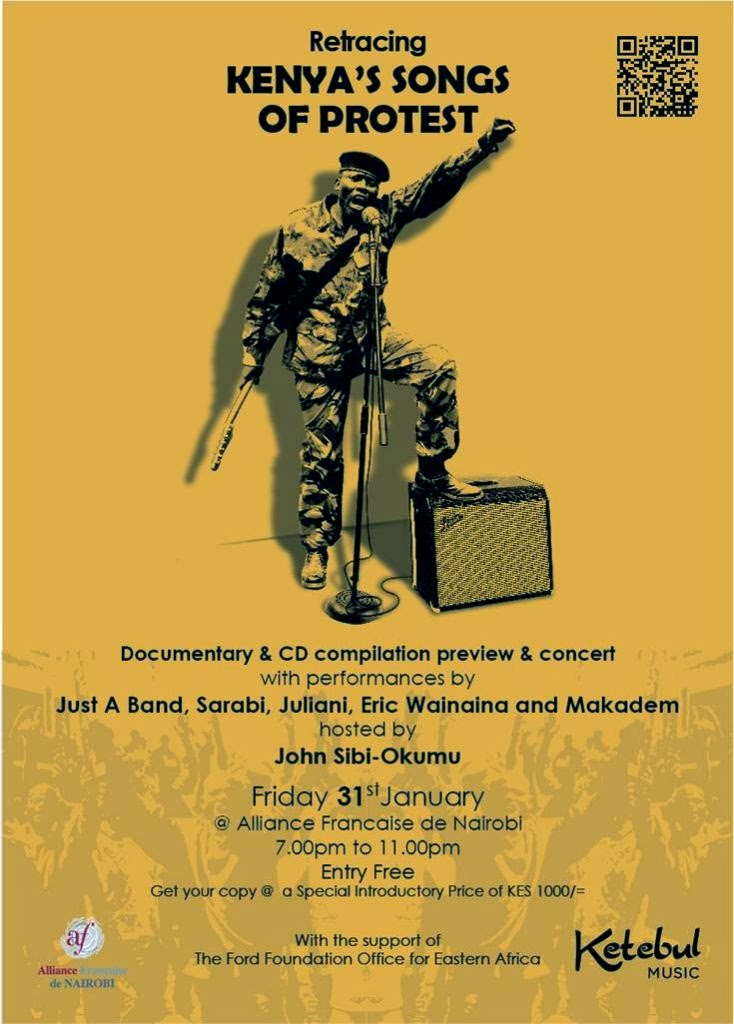
Event: Kenya’s Songs of Protest: Documentary & CD Compilation Preview Concert, Jan. 31 2014 @ Alliance Française

Songs of Protest
In the recent past Kenya experienced different forms of protest. The protests have ranged to the eye catching Occupy Parliament protests lead by photo activist Boniface Mwangi protesting the high pay Members of Parliament enjoy to the recent protests against new taxes by county governments.   

Musicians have not been left behind and you have quite a number of young musicians telling truth to the people in power through music. Some of this music is quite popular since it deals with issues of bread and butter and the current problems being experienced. 

Therefore the exhibition above ought to be a MUST attend event for anyone interested in issues of governance.

Particulars
Date: January 31, 2014
Venue: Alliance Française
Time: 7-11 pm
Free Entrance


Performance by: Just a Band, Sarabi, Eric Wainaina and Makadem
Hosted by: John Sibi-Okumu

Friday, January 24, 2014

Opportunity: Washington Fellowship of Young African Leaders 2014 by January 27 2014

Lecture: Origins of Political Order by Prof. Francis Fukuyama on Jan. 22 2014 @ Strathmore Business School

Lecture Poster
Professor Francis Fukuyana gave a lecture titled the Origin of Political Order on Wednesday evening at the Strathmore Business Auditorium. The lecture was premised on his most recent book going by the same title.  The professor kicked off his lecture by giving us a background on the thought process plus what influenced him to come up with this book. The September 11 2001 twin tower attacks by terrorist and America's quest to attack Iraq and result to a nation building war / exercise were the catalysts. Hence he embarked on a search of the origins of political order since intervention by the United States tended to get things wrong on the countries that they wanted to 'democratise'.

The professor also enumerated the evolution of political order and classified this into three components namely;

  1. The State [the formation of the state as we know it today by the Chinese and how war and dynasty conflicts was instrumental to this. Notable was the mention of German Sociologist Max Weber]
  2. The Rule of Law [under the rule of law the professor highlighted the role of religion and notable mention was Pope Gregory the 7th and his work on reforming the Catholic Church]
  3. Institutions of Accountability [Lastly, was democracy and why he prefers to Accountability as opposed to democracy]
On the last classification, the professor went to great lengths to showcase that in authoritarian regimes such as China there is considerable accountability in this case in economic terms. The central committee is try as much as possible to secure economic opportunities for its citizens and this nuance is as a result of its unique history. 


Lastly the Prof. Fukuyama tried to tackle Africa from the position of an outsider. He concurred with the Africa Rising narrative and made specific observations. He then concluded by making us aware of a sequel to his book will be published this year. The book looks at the origin of political order in Africa.

The output and learning points from Prof. Fukuyama was there is need to understand local nuances before engaging in democratisation projects by international institutions. I think his works might inform current concepts such as R2P.

Find Prof. Fukuyama Bio and his current projects here: http://fukuyama.stanford.edu/

Thursday, January 9, 2014

IMF’s MD Christine Lagarde Visit to Kenya: Dispatches from Mindspeak Forum

Mindspeak Poster
I attended the Mindspeak forum on Monday, January 6 2014 where the key guest was the IMF MD Christine Lagarde. Ms Lagarde was in the country for a three day working visit.

Ms. Christine Lagarde, Managing Director of the International Monetary Fund (IMF), will visit Kenya from January 5–8, 2014, to meet with policymakers and other representatives of Kenyan society. – IMF Press Release No. 14/01 January 2,2014

Notable things picked from this session is despite the look east policy adopted by Kenya plus the perceived thawing of relations brought about by the ICC case the country has been engaging the IMF. To date Kenya has received almost $ 1 B from the time IMF. The monies we necessitated by a rapid decline in the value of Kenya Shilling to the dollar in the year 2012. The country applied for IMF short term lending which was approved and disbursement of these funds was divided into three tranches. The last which was approved by the BoD of IMF just before Lagarde jetted in.

Other insights gain from the MD speech was the health of Kenyan Economy. As pointed out –

‘Indeed, Kenya’s economic gains over the past few years have been nothing short of remarkable. Coming on the heels of a delicate political transition, growth remains robust—at more than 5 percent in 2013. And a set of bold economic reforms have laid the foundations to lift the economy to middle-income status within the next decade—if Kenya maintains the reform momentum.’ - Christine Lagarde

This is essentially important given Kenya will be launching a Eurobond either at the end of this month or in February 2014. The assurances from the IMF will certainly go a long way in making the bond issue a success.

The other aspects which were addressed by the speech were the growth prospects for SSA tagged together with the risks to look out for. In her off the cuff remarks Ms Lagarde mention with the recovery of Western markets capital is expected to flow back from emerging markets to the developed markets as the returns there become more meaningful.

‘Overall, we expect Sub-Saharan Africa to enjoy continued robust growth—which our projections in October place at 5 percent in 2013 and close to 6 percent in 2014. But this outlook is not without risks. Policymakers must remain vigilant to threats from slower demand in emerging market economies, unfavorable changes in commodity prices, or higher financing costs.’ - Christine Lagarde

On the quest of Middle Income Status by Kenya m/s Lagarde offered a roadmap in her three C’s namely;
  1. Completing fiscal devolution; 
  2. Closing infrastructure gaps; and 
  3. Continuing regional
The full speech by m/s Lagarde can be accessed here

Thursday, October 24, 2013

King's Speech Oops.. the Presidents Speech! Uhuru Kenyatta's Africa Union Speech

President Uhuru Kenyatta's speech delivered in Addis Ababa at the Extra Ordinary Session of the Assemblies of Heads of State and Government of the African Union was a Kantian moment in two instances. First, in terms of his presidency the president came out guns blazing against the West and their ideals of justice. Second, in terms of African Union politics the president has started a discourse that is certainly going to continue in terms of AU engagement with powers outside the continent.

In his speech the president was as blunt as they come and gave a stinging attack to Western Nations.
Some of the snippets from this speech below shows the president has had a change of heart albeit now that he is in power and as such the gloves are now finally off.
First, that world powers were hesitant to a process that might make them accountable for such spectacularly criminal international adventures as the wars in Iraq, Syria, Libya, Afghanistan and other places, and such hideous enterprises as renditions and torture. Such states did not, therefore, consider such warnings as applicable to pacific and friendly parties.

Secondly, it was the understanding of good-faith subscribers that the ICC would administer and secure justice in a fair, impartial and independent manner and, as an international court, bring accountability to situations and perpetrators everywhere in the world. As well, it was hoped that the ICC would set the highest standards of justice and judicial processes.

This speech represents a defining moment in Uhuru Kenyatta's presidency and as such we could start percing events in Kenya in context of the pre AU convention speech and post AU convention speech. What remain is to see if he will appear at the ICC on November 12, 2013 or he will follow the AU resolution that asked him not to show up at the Hague.

Find the Presidents full speech here

Friday, October 18, 2013

Trial Chamber V(b) conditionally excuses Uhuru Muigai Kenyatta from continuous presence at his trial starting on 12 November 2013

Press Release: 18.10.2013

Situation: The Republic of Kenya
Case: The Prosecutor v. Uhuru Muigai Kenyatta

Today, 18 October 2013, Trial Chamber V(b) of the International Criminal Court (ICC) issued its decision conditionally granting, the request to excuse Uhuru Muigai Kenyatta from continuous presence at his trial, scheduled to start on 12 November 2013. The decision was adopted by majority, Presiding Judge Kuniko Ozaki dissenting. The Majority however required Mr Kenyatta’s physical presence for the entirety of the following sessions: the opening and closing statements of all parties and participants, hearings when victims present their views and concerns in person, the delivery of judgement in his case and any other attendance ordered by the Chamber. If applicable, Mr Kenyatta is also required to be present during sentencing hearings, the delivery of sentencing, the entirety of victim impact hearings, as well as reparation hearings.

The Majority asserted that violations of any conditions of Mr Kenyatta’s excusal may result in revocation of the partially granted request, and/or the issuance of an arrest warrant, where appropriate.

The Majority reiterated, in a similar vein to Trial Chamber V(A)’s decision of 18 June 2013, which granted Mr Ruto a similar relief, that Mr Kenyatta’s excusal is strictly granted to accommodate the demanding functions of his office as President of Kenya, and not merely to gratify the dignity of his own occupation of that office.  

The Majority also stressed that granting such an exception is motivated in part by not only the need to ensure the fairness and expeditiousness of the trial in full respect to the rights of Mr Kenyatta as an accused, but also, the need for due regard for the protection of victims and witnesses.

Judge Chile Eboe-Osuji appended a separate concurring opinion, and Presiding Judge Kuniko Ozaki appended a dissenting opinion.

Background:
Mr Kenyatta is charged, as an indirect co-perpetrator, with five counts of crimes against humanity consisting of murder, deportation or forcible transfer, rape, persecution and other inhumane acts allegedly committed during the post-election violence in Kenya in 2007-2008. Charges were confirmed on 23 January 2012, and the case was committed to trial before Trial Chamber V(b).

In the context of the Kenyan situation, two other cases are currently before the ICC: The Prosecutor v. William Samoei Ruto and Joshua Arap Sang, and The Prosecutor v. Walter Osapiri Barasa.

On 18 June 2013, Trial Chamber V(a) had, by majority, granted Mr Ruto a conditional excusal from continuous presence at his trial. However, on 20 August 2013, the Appeals Chamber suspended the implementation of this decision, pending a final determination of the matter. The Appeals Chamber will issue its decision in due course.

The International Criminal Court is an independent, permanent court that tries persons accused of the most serious crimes of concern to the international community as a whole, namely the crime of genocide, crimes against humanity, war crimes and the crime of aggression.
Wednesday, October 16, 2013

Stinging Criticism of Kofi Annan by Eric Ngeno - Uhuru Kenyatta's Speech Writer

The gloves are off and in the run up to November 12, 2013, the day President Uhuru Kenyatta is expected to appear at the International Criminal Court. The administration seems to take all avenues to prevent such an occurrence. There has been lobbying of African Heads of State through the African Union Forum and I presume there has been other avenues that have been sought [diplomatic or otherwise].

However, as that goes one there seems to be a movement to injure the reputation of Kofi Annan, former UN secretary General and mediator of Post Election Violence in Kenya. Today's opinion piece in the Daily Nation by the President's speech writer is a panacea on what the administration thinks of Kofi Annan. Eric Ngeno goes ahead to call the former United Nations Secretary General Kofi Annan a conductor of the International Arena.

We wait for the next few days and see the play of action from all quota's.
  

Wednesday, October 9, 2013

The World Bank Group Fellowship Program for PhD Students from the Continent

Find full information here

ICC Decision on the Request of the Kenyan Government to Submit Amicus Curiae Observations

Yesterday, 8 October 2013 the Trial Chamber V(a) of the International Criminal Court (ICC) issued a decision on the case The Prosecutor v. William Samoei Ruto and Joshua Arap Sang.

Decision on the Request of the Government of Kenya to Submit Amicus Curiae Observations
The Chamber authorises the Government of Kenya to Submit Amicus Curiae Observations in response to the “concern raised by the Court regarding the possible impact of the resolutions made by Kenya's National Assembly and Senate [...] regarding Kenya's withdrawal from the Rome Statute”.
 The Government of Kenya should file its written submissions no later than 16 October 2013 at 16:00. Parties and participants are invited to file their responses to such submissions no later than 18 October 2013 at 16:00.

Context: According to Rule 103(1) of the Rules of Procedure and Evidence of the ICC, at any stage of the proceedings, a Chamber may, if it considers it desirable for the proper determination of the case, invite or grant leave to a State, organization or person to submit, in writing or orally, any observation on any issue that the Chamber deems appropriate.

The Chamber is currently considering the issue of the impact of the debate and resolutions of the Kenyan Parliament regarding Kenya's status as a State Party to the Rome Statute on the safety, physical and psychological well-being of witnesses testifying in the Ruto and Sang case.

Judges have considered that “submissions from the Government of Kenya on these resolutions may be of assistance to the Chamber [… and] desirable for the proper determination of the issues under consideration by the Chamber.” 
 Download Decision on the Request of the Government of Kenya to Submit Amicus Curiae Observations

For more information on this case visit the ICC website