Showing posts with label Opinion. Show all posts

Friday, September 27, 2013

China Intentions Laid out in Canvas and Captured on Lens by Lintao Zhang of the AP on Sept. 22 2013 at the Great Hall of the People

Maduro in China Photo by Lintao Zhang/ AP
I came across this photo that might illustrate China's intentions. In official policy documents and in my interaction with Chinese activities and actors in Africa China I have heard of the harmonious coexistence narrative

So is the peaceful rise Beijing seeks to illustrate true?
Well, there is a whole debate on that with American watchers and Chinese analysts embraced in controversy as to what this exactly means.
  1. Peaceful Rise of China: Myth or Reality? by Jianyong Yue
  2. China’s “Peaceful” Rise? By Joseph S. Nye
  3. Review of When China Rules the World by Martin Jacques by Michael Rank

Given that events in China are clearly choreographed one can come up with the conclusion that the above mural was not mounted in the Great Hall of the People by accident.

Tuesday, August 6, 2013

Euro-centric Reads: What to Read on Kenyan Politics by Prof. Joel D. Barkan

Prof. Joel D. Barkan presents a commentary on Kenya’s foreign affairs syllabus reads in the Council of Foreign Relations hosted publication Foreign Affairs. When I read the article I noticed some glaring omissions and deliberate characterization of Kenya’s history. First, to come to my eye was the division of Kenyan history into three epochs.
Its [Kenya’s] history can be divided into three eras: the late colonial period and the transition to independence in 1963; the post-independent period from 1963 to 1990; and the country’s two-decade-plus struggle since to become a modern democratic state. - Joel D. Barkan
In my opinion the post 1990’s period cannot be balked into one set and as much as the Kenyan state has had its struggles in transforming to become a modern democratic state. The new millennium should have merited an era by itself so that in the least we had at least four eras. The most notable and significant events in the Kenyan state have happened in the new millennium. The most notable being the smooth transition of power in 2002 from the then monolith KANU to the opposition party NARC. The election period and coming into force of a coalition government in 2008 after a bundled general election in 2007 and almost eventual collapse of the state. Then there is the coming into force of a new constitution in 2010 and challenges thereafter and problems within the framework of the coalition. Throughout the period of 2008 to 2012 Kenya has had its fair share of influence and interventions by international actors. Also, it’s during this period is when the ICC court came calling with significant consequences in the long haul.
My second problem with Prof. Joel’s piece is his collection of publications which he curates. The readers of this piece are typically non-Kenyans and they might not have the local knowledge we possess and thus they might miss some quintessential narratives. A good example is his analysis below that follow the era one reads.
Like most African countries, Kenya is a multiethnic society created by European colonialism. Unlike most former colonies, though, its territory was extensively settled by Europeans. That process resulted in a system of racial domination similar to those that emerged in Zimbabwe and South Africa. - Joel D. Barkan
While it is true Kenya is a multiethnic society with its fair share of problems tribalism being one of them. The settlement by Europeans could be considered extensive however this settlement happened in the fertile areas within the country. This resulted in the phrase ‘white highlands’ being coined .  
My bone of contention with Prof. Joel is in analyzing the present day contemporary politics he did not branch out of academic circles to explore modern day contemporary literature. Kwani? Publications offer insights into the contemporary political landscape. Also, his curated list lacks some African voices especially the pre-independence era. Facing Mount Kenya by Jomo Kenyatta is a book he ought to have considered for inclusion plus Not Yet Uhuru by Jaramogi Oginga for the second era.
In the same breath I must say I agree with most of the assertions presented in the article especially concerning few publications covering the present day contemporary politics.
Regrettably -- and somewhat surprisingly -- no concise overviews of contemporary Kenyan politics have been published in recent years. - Joel D. Barkan

Perhaps this could be explained by the mere fact that unlike the West where there are foundations which support such endeavors. Plus, universities which have a strict tenure system where a professor’s tenure is based on the number of publications and research projects they have done. In Kenya there are very few foundations which engage in supporting universities to conduct and publish this kind of research. This has lead to a phenomenon where you have researchers from the north jetting in to southern countries and conducting research funded by foundations from the northern.

Wednesday, October 24, 2012

Dispatches from Addis Ababa: Day 1 – First Impressions Do Matter

These are my impressions of Ethiopia in last 24 hours I have been here in Addis Ababa;
Meles Zenawi is King!
Once you land in Addis Ababa airport you have portraits of the former prime minister everywhere. The people here also hold their former PM in high regard.
The Chinese are in Town
The Chinese are in Ethiopia just like any other African capital. Their presence is seen immediately you land on the arrivals. You also have a glimpse of their activities. Currently, they are building the road from the airport.
Addis Ababa is the New York of Africa
In the evening we we’re taken to Yod Abyssinia cultural restaurant and the melting pot Addis Ababa become crystal clear. This restaurant was full house with visitors from all over the world. The Ethiopians despite western influences have managed to preserve their culture.
GDP growth at 11%
I was surprised when someone pointed to me that Ethiopia has a GDP growth rate of 11%. This is one of the highest growth rates in Africa. This is evident from the construction I see around me.  
Ethiopians are Reading
I observed quite a number of bookshops yesterday and on my evening walk. I popped into one bookshop and I saw quite a number fiction books by Mario Puzo.
The Taxi Drivers
The reputation of Taxi drivers in Ethiopia precedes them! Yesterday I experienced it firsthand.

Friday, October 5, 2012

Opinion: The selection of three fellows for 1beat Program is evidence of #Kenya’s rising status as a cultural hub

One Beat Festival
What happens when you bring musicians from different continents in one country for a tour and residency program? Well, you have yourself smart power and that is what the United States of America has been up to of late. This is through the 1beat program that brought together 32 fellows from 21 countries to the US for tours and residency program.
What is 1beat?
OneBeatSM is an international music exchange that celebrates musical collaboration and social engagement through innovative people-to-people diplomacy. From September 10 – October 7, a group of exceptional young musicians from around the world will collaboratively write, record, produce, and perform original music in venues ranging from concert halls to city parks to rock clubs.  In addition to creating new work, OneBeat Fellows will partner with community organizations, schools, and socially-engaged local musicians to offer workshops, performances, and public dialogues.
Which Musicians Represented Kenya
Kenya is a bastion of sports especially track races and marathons but what is now emerging is that Kenya is also rising as a cultural hub. This is evident in selection of three Kenyan musicians out of eight who represented Africa. The musicians who represented Kenya are;
  1. Nina Ogot: http://www.1beat.org/artists/nina-ogot/
  2. Muthoni the Drummer Queen: http://www.1beat.org/artists/muthoni-ndonga/ and
  3. Kato Change: http://www.1beat.org/artists/kato-change/
Other countries represented are Democratic Republic of Congo (with two musicians), Nigeria, Mozambique and Senegal each with one representative.

Check the photos and updates from 1Beat tour on their Facebook page

This post was first published on NairobiNow

Monday, September 3, 2012

Politics: Hon. Charity Ngilu Tosses Her Hat into the Presidential Ring


Hon. Charity Ngilu [Current Water Minister] becomes the second woman after Martha Karua to toss her hat into the Presidential Contest ring.  Charity Ngilu launched her presidential bid yesterday at KICC. In a well orchestrated party delegates conference that saw her endorsed as the party's flag bearer on Narc party. 
This will be her second shot at the presidency after 1997 polls that saw her come number four. 
Many of us will remember Ngilu as being instrumental in the 2002 polls. She was the one of the leading lights who advocated for the then opposition to unite. Her efforts bore fruit and saw President Kibaki then head of opposition on Democratic Party ran on her party ticket Narc Kenya as a compromise party and saw the opposition through Kibaki clinching the presidency for the first time. 
She later fell out with the president and has been closely linked with the prime minister's ODM party.  In 2007 election she was the only woman pentagon member. She was given leeway by the ODM party  to contest her Kitui Central seat on her Narc Party.

Observers have pointed out that she is launching a presidential bid to increase her odds of being picked by the PM as a running mate.

The positive thing but her run for presidency is that it is igniting the ongoing campaign with fresh ideas especially on policy as opposed to name calling we have been getting. During her launch she set out the priority areas her administration would focus on. These are;
  1. Eradicating poverty;
  2. Fighting illiteracy;
  3. Improving healthcare;
  4. Women empowerment and
  5. Enhancing food and water security in the country
However, this seemed like a well choreographed reading of her party manifesto as opposed to what she believes in.
Critics will be eager to point out that her ministry has not been one of the best performing and we have had instances of corruption pointed out in this ministry. 
She is also ranked as an average MP on Mzalendo platform


Thursday, August 30, 2012

2nd Year Anniversary since the Promulgation of the New Constitution-What has changed?


Kenya celebrated the second anniversary since the promulgation of the new constitution without much fanfare. On this day [August 27] two years ago Kenya had ushered in the new constitution with celebration and fanfare at Uhuru Park. There was a lot of hope as we set in a new constitution two years ago. However, we seem to have gone back to our old ways. One would have expected this being an important day we would have gone back to see the success that we have achieved so far. However, the air is now filled with talk of 2013 March polls and with it comes fear of a repeat of what happened in 2007/08. So the president through the Ministry of Justice & Constitutional Affairs requested for peace forums to be conducted in all counties and on August 27, 2012 was the culmination of this forums. The agenda for this day was peace. This peace conference that was attended by all branches of government. 
Wisdom of COE
The drafters of this constitution, the Committee of Experts CoE had foreseen a legislature NOT keen on enacting new rules on time and had come up with an inbuilt timetable on which parliament was expected to pass in key legislations to give life to this constitutions. Failure to which the legislatures would be sent packing if citizens petitioned parliament. Any citizen could petition parliament for failing to enact laws as spelt out in the fifth schedule in court and have parliament dissolved on this account. Also, this constitution created Constitution Implementation Commission CIC to track and make sure Parliament and Executive carry out the key legislations required by this constitution following the letter and spirit of the new leviathan.

The Good
Within this span of two years we have had our success especially when it comes to the appointment of new judicial officers beginning with the chief justice, the setting up of Interim Electoral & Boundaries Commission IEBC.
The CIC led by Commissioner Charles Nyachae has live up to its bill and has always been forthright with Kenyan’s on matters pertaining to implementation of the new constitution. Other successes of this constitution have been the Kibunja led Commission, National Cohesion & Integration Commission NCIC that tracks instances of hate speech. This body was created by the COE to make sure that incidences of hate speech similar to those that occurred in run up to 2007 elections do NOT occur again. This body has made sure our MP’s do whip up ethnic vibes in the run up to the March 2013 polls.

The Bad
As much as we have done well in some spheres of implementing the new constitution we are lagging behind on reforming our police force. Currently, we have a reformed Judiciary [however, the CJ has been on record saying it will take a few more years until we achieve international standards]. However, as we approached the second year anniversary the last date according to the schedule on implementing the new constitution that we should have an Inspector General. A new inspector General has not been appointed. The position of Inspector General is a new post created by this constitution. The Police have been of the opinion that they do NOT favor a ‘civilian’. This is a term meaning that they would prefer one of their own ‘rank & file’ to ascend to the new position. It remains to be seen what will transpire.

The Ugly
However, even with the new constitution in place we have seen the emergence of Mombasa Republican Council MRC which calls for the cessation of the Coast Province from Kenya. Its clarion call is ‘Pwani si Kenya’ meaning Coast in not in Kenya.
The other big problem we face as a nation has been the eruption of violence in Tana River delta and the emergence of trouble this week at the Coast after the broad daylight assassination of Sheik Rogo who is linked to have ties with Al-Qaida.
We have also witnessed the rise of tensions and animosity in the country with the Miguna Miguna book tour of Kenya. To me some of these happenings seem orchestrated.

Friday, October 14, 2011

ICC Confirmation Hearings

The ICC confirmation hearings taking place in the month of September as usual got most of the country glued to The Hague. The national discourse was ICC confirmation hearings and this was made possible by the media. The main TV stations NTV, KTN, K24 Citizen TV and K24 disrupted the normal programme schedule to broadcast the ICC confirmation hearings. The newspapers were a splash with what or what did not happen at The Hague and the radio was also full of the confirmation hearings

This spotlight of Hague was there despite some calamities taking place in Nairobi (pipeline explosion) and accidents taking place in the country.

However, for me this time round I watched the debate unfold on social media sites twitter however, during the evening I was able to watch a few of the first bunch of confirmation hearings which involved MP’s Ruto, Kosgey and Journalist Sang.

The second bunch of confirmation hearing attracted my attention because the Finance Minister was going to testify as his own witness and I looked forward to see the ‘battle royal’ as it had been called in the media between the prosecutor L. M. Ocampo and the Finance Minister. In fact Gado the Daily Nation cartoonist had painted Mr. Uhuru Kenyatta in gloves ready to ‘engage’ the prosecutor!

I missed this ‘confrontation’ because an event popped up that I had to attend at the iHub. Nevertheless, I was able to see a read and see what happened in the news. It had been billed as a risky move by the Finance Minister but going by what I observed and comments made by persons is that the gamble by Finance Minister paid off.

Observations
Finance Ministers counsel was damn good. During the initial appearance there was backlash on twitter as to why the Finance Minister was engaging the services of foreigners yet in Kenya we have good lawyers. However, during the confirmation hearing I was able to see the smart move taken by the Finance Minister.

There was a huge contingent of media personalities composed of all the anchors of stations in Kenya (worthwhile to mention Jeff Koinange of K24 who even had an exclusive with the prosecutor!) who went to The Hague.

There were PR practitioners for Mr. Uhuru and bloggers among his contingent.

From the court perspective, the presiding judge was tough and fair as usual. The witness lawyer was also very good.

Back Home
The week the finance minister was on the doc I noticed some graffiti on some walls showing solidarity with the finance minister. So what is unique with this graffiti is that it has the Obama hope signature in it. It is worthwhile to note that though I do not know who was behind it. This is definitely done by young people. This I think goes to show that the Finance Minister has some fanatical following in some quarters.
Next to the Museum

In town at a matatu Station

In town at a matatu terminus
Suggested links
http://www.icckenya.org/
http://www.dennisitumbi.com/ (this might have a perspective that leans towards UK)
http://www.youtube.com/watch?v=Mw4JbEud4bU&feature=related (Humor video on O'campo 6)

Monday, October 3, 2011

The Lord Mayor of London and Smart Diplomacy

The Lord Mayor of London Alderman Michael Bear was in town and had a series of meetings and concerts running from September 9-10, 2011 in various locations. His visit to Kenya was not for pleasure and NOT exclusively for business but for both!

Smart Diplomacy
In what is currently dominating the Western world, soft power as opposed to hard power is now being practiced. Smart power is a theory that has been espoused recently where nations combine both hard and soft power. In the foreign policy magazine/website the multi-literalist has observed correctly that Europeans are good at using soft power and has attributed this to the European Union. Under the EU treaty EU member states come together and negotiate policies and decisions. So this it is believed has made Europeans better diplomats who appreciate the aspect of understanding other people’s culture and points of view.

The Lord Mayor Alderman appreciates culture and has a strategy for his mayoral year which he calls ‘cultural diplomacy’. He is using this strategy to support the city of London and its global agenda. Under this strategy he has partnered with Concordia Foundation.

Concerts all over the World
Concordia Foundation is expected to present concerts for the Lord Mayor in Britain and during his international visits some of which include Vietnam, China and Kenya.

I was invited to the concert at the BHC residence on Saturday September 10, 2011 and was delighted by the evening performances.
The evening had performances from our very own Moipei sisters, Rishabh & Akshay Sevak and Concordia Artists Satoko Fukuda, Couple Gareth McLearnon & Abigail Burrows and Jeremy Silver who was perfect on the piano. Gillian Humphreys founder and artist director of Concordia Foundation also gave a performance for the evening.

After the evening performance I had a rare chat with the Lord Mayor and we talked among many things his root with Kenya and football. The Lord Mayor was born in Kenya and is an Arsenal Fan. At the time of the meeting Arsenal was not at their best and the Lord Mayor was as is any other football fan sticking with his team ‘for the better or for the bad times’. I on the other hand am a Manchester United fan! Going by the Kenyan standards there are some ‘rivalry’ between Manchester United and Arsenal as opposed to Manchester United and Liverpool that exists in UK.

Duties of a Lord Mayor
So during my encounter with the Lord Mayor I came to learn a few things. One was the difference between the Mayor and the Lord Mayor. Most of us had gone there expecting to see the mayor.
In terms of duties the Lord Mayor made the differences of these two offices crystal clear. The Lord Mayor makes the money and the London mayor spends it!   

The office of the Lord Mayor is an elected post which one holds for one year. The Lord Mayor is head of City of London Corporation. Among his many duties he is expected to travel extensively in liaison with FCO (Foreign Commonwealth Office their Ministry of Foreign Affairs) hence he had a reception at BHC residence. 
From this travels he is expected to foster goodwill and boost British trade, particularly the markets and services of the city. The city of London has a vibrant capital markets and for those following the current impasse of the Euro (which UK is not a member) and debt crisis facing Greece and other periphery nations of the EU will understand that Germany and France have been playing a key role. 
The city of London is the financial power house of Europe (home of global capital) and most of the off shore banking in Switzerland is usually done from London.

The Lord Mayor and his Appeal
The Lord mayor Alderman Michael Bear has an appeal which is called ‘Bear Necessities’. His appeal is aimed at helping children in London access education and have greater life opportunities and at supporting international disaster relief.

Wednesday, September 14, 2011

The Winds from Beijing


The Chinese community in Nairobi had a rare concert/Performance on September 8, 2011 at the University of Nairobi Taifa Hall.  The performance was aptly titled ‘The wind from Dunhuang’ and was performed under the auspices of Forum for China Africa Cooperation (FOCAC) which China in cooperates a culture aspect of engagement with Africa.
So under this auspices China has a Chinese Culture in Focus 2011 calendar of events in which it organizes exhibitions, performances, concerts, operas, kite flying and Chinese book fairs in countries where it has a presence in Africa. Some of these countries are Mauritius, Tanzania, Seychelles, Gabon, Burundi, Ethiopia, Nigeria, Zimbabwe, Senegal, South Africa and Kenya.
The last two countries South Africa and Kenya experiencing a lot of contact and spotlight from Beijing now that Egypt the seat of FOCAC  is undergoing some turbulent times as a result of the Arab Spring/Uprising.
The Event
The event was set up at the Nairobi University grounds which houses the Confucius Institute and has been very cordial to China under Prof. Magoha’s tenure.
The performance was an evening event and by 7.30 the hall was half full of Chinese living in Kenya (Some of the with Jackets with the logo of Wu Yi a Chinese company constructing Thika road) and few students (some Chinese students) and other students at the University who out of curiosity wanted to see what was happening in the hall.
A table with red piece of cloth was set for the dignitaries at the front (Chinese ambassador to Kenya and other dignitaries accompanying the troupe on its tour of African countries).
The Performance
The performance started at 8pm and we were treated to some great performances on this evening. A dance: Raise your bridal veil kicked off the evening with Chinese drums playing in the background. Mind you the evening performances were done with a playback on the background. There after a female solo: A glass of good wine was performed by one of the MC’s.
Tibet
We were also given a folk dance number from Tibet: The Love Song of Kangding and boy that dance was perfectly executed. This showcased the liveness and kind of shyness of Tibetan girls and later we were treated to a male group dance-the happy Tibetans (Political undertones?)
Mongol
Showcasing the diversity of China we were treated to a play of Matouqin. A Mongol string musical instrument with two aptly titled performances; A thousand horses are galloping ahead and sing a spring song in pasture
Acrobatic Shows
Also on the menu from China was an acrobatic show which was good and a unique skill in Sichuan opera-Changing Faces which great.
Friends, Partners & Brothers
Just as we have a book by Elizabeth Gilbert with the philosophy of eat, pray and love. The philosophy or the mantra that Beijing is sending out to Africa was out there to be showcased.
The evening ended with these words ‘Friends Partner Brother’ in a banner. This is the message that Beijing is sending out to Africa.
Now I am looking forward to Embrace China-Performance and visit by Chinese Arts Troupe and Chinese Book Fair.
The Return of China to Africa
Dan Large’s book The Return of China to Africa is a worthwhile read to understand the China-Africa Geopolitics.

Friday, July 15, 2011

Southern Sudan. Free at last?

July is turning out to be a historic month in many fronts. Last weekend July 9, 2011 witnessed the birth of the republic of Southern Sudan. The previous day had seen the final flight of US space shuttle program. End of US monopoly in space? Well the jury is NOT yet out on this one.

Neighbourhood
Back at home (Kenya) there has been lots of discussion of what this ‘new’ neighbour (South Sudan) means to us! Kenya was the host of the negotiation for the peace process and is home to many Southern Sudan. Going by what I have been hearing we seem to be expecting too much from this young nation. Considering it said to have a huge oil wealth and lots of resources which are yet to be mined.

Resent Events
Kenya is among the first nations in the world to recognise Southern Sudan and there has been talk of Southern Sudan joining the East African Community.

It is too early to judge what role Kenya is playing in the new Salva Kiir’s administration in Juba. But going by sentiments witnessed on television, NTV (Nation Television) Kenya wants to reap the peace dividends.

Major TV broadcasters cancelled their schedules to broadcast live the happenings in Southern Sudan. In fact I had gone home early expecting to watch some bit of live TV and the usual county madness of Lolani Kalu on NTV only to realise NTV had cancelled it’s county screening and moved to juba

So we were able to watch the pre and post independence celebrations of the people of South Sudan where also Kenyan elites had gone to witness the birth of the new republic.
Political pundits were also on TV giving their views on how the unfolding events were going to impact Kenya.
The dallies were also not left behind and Kenyan political differences were put aback and the headlines focused on Southern Sudan with tag line lines ‘Southern Sudan, free at last’.

So 1960’s in the region
So all of a sudden we get a feel of what our folks felt like in 1960’s going by the celebrations emanating from South Sudan. If a global happiness index is to be conducted then Southern Sudan would top the world rankings.

The Future and Destiny of South Sudan
I am happy to see the Sudanese who have been able to fulfil ‘the right to self determination’ and thus they have become the newest member of global states (193 according to UN).
However, the hard part of nation building has began and they young nation will be confronted by key questions such as;
  • How to undertake Nation building (How this new state is going to carry out the delicate process of nation building).
  • How to handle the issue of Abiyei (oil rich region)
  • How to use the oil resources.
  • Its relation with Kenya. How the new administration in Juba views Kenya and how it interacts with Kenya.
Nobel Peace Prize
As the South try a hand in nation building it would be good for the Norwegian committee to realise they extraordinary feat and perhaps reward the parties that secured the peace in this unstable region. Perhaps, the Somali’s might have been watching the events as they unfolded and might be convinced otherwise!

Tuesday, June 28, 2011

‘Boston Tea Party’ at the Kenyan Parliament

The Kenyan Parliamentarians are currently embattled in a war of words with the tax man on weather they ought to pay taxes on their allowances. The legislatures have ONLY been paying taxes on their basic salary and NOT paying taxes on their allowances. So as one would have it. Their basic pay or salary is minimal compared to the allowances they have given themselves.

New Beginnings
However, with the enactment of the new constitution Kenya is moving from business as usual to business unusual. The legislatures seem NOT to have read the section of the constitution or mistakenly though the section, that states ‘no one is exempt from paying taxes’ would NOT apply to them.

The legislatures were a taken by surprise when the Commissioner for domestic taxes wrote to Parliamentary Service Commission (PSC) asking them to pay the taxes on their allowances backdated from August 27, 2010. Albert the date the new constitution was ratified.

Judiciary and Taxes
To add misery to their woes, the judiciary under the new chief justice Dr. Willy Mutunga has shown willingness to pay their taxes. Judges being constitutional office holders were not subjected to payment of tax in the old constitution.
However, when Kenya Revenue Authority (KRA) wrote to the new Chief Justice (CJ) who was yet to finish a week at the helm asking for the judiciary to pay their taxes he obliged to their request. He went further and called the KRA asking the taxman to help the Judiciary carry out their request!
Imposition of Taxes
The MP’s on the other hand were busy showing cause why they ought NOT to pay taxes. Arguing on flimsy grounds such as ‘an employee should not have his salary reviewed downwards while in office’ other were the opinion that this cause was not effective ‘floating clause’ which ought to be effected in the next sitting (after 2012 elections).

When this did not do the job name calling was resulted with some MP’s thinking the commissioner for domestic taxes was ‘cheeky’ because he informed the media on his cause.

Softening?
However, few MP’s have read the mood of the nation and are now coming full circle. Some have already paid their taxes (It has been reported the PM has done his duty in giving what belongs to Caesar unto Caesar and other MP’s are following suit).

It must be said there were a number of legislatures who were paying taxes on their allowances beginning with Johnston Muthama and later followed by the likes of Peter Kenneth. The speaker of the National Assembly had caused uproar to the citizens when he had remarked under the old constitution that the ‘legislatures were free to pay their taxes on their allowances if they felt reasonably philanthropic!’

So this marks another version of ‘Boston Tea Party’ only this time it is in the reverse!

My Bank, My Kiosk, My Social Friend!

A while back, Bankele blogged about the raise in number of Banks to the neighborhoods in ‘Your Bank, Your Neighbour’ where he observed rightly Banks have brought their services closer to the people.

Equity Bank Agents
This closeness to the customer seems to be taken further by Equity Bank. The Bank recently introduced agent banking where you can do some banking services in your local Kiosk under an Equity registered agent. To do this the bank gets commercial outlets to act as its Branches. This is a very innovative aspect the bank has undertaken since it will save the bank huge amounts in terms of establishing branches and this might lead to a slow down on its regional expansion.

Mobile Money
Also, the bank has been catching up on the M-Pesa (Mobile Money Transfer) services by launching on M-Kesho. Kenya has earned a place for itself by being the new Silicon Valley in terms of Mobile innovations. This has seen the setting up of i-Hub (A social gathering place for techies which has links to the big Tech companies such as Google, Microsoft and Nokia).

Equity Bank has always been in the look out for new and innovations and ways of doing business and has not been left out of the equation so to speak by foreign technology companies. The Bank partnered with Safaricom (The regional Mobile Telephone big player which has links with Vodafone) to bring into the market mobile Money transfer between the clients of Safaricom and Equity Bank.
It must be noted that Safaricom successfully incorporated M-Pesa (mobile money transfer) under Michael Joseph (first CEO of Safaricom who built the company from inception and left in 2010). It was back then a project which was being tried for viability by Vodafone funded by DFiD.

Social Media
Banks have been known to act conservatively (apart from the hedge fund practices in the western world which caused the global financial crisis). The banks in Africa have remained conservative in their practices. However, this seems to be changing because they are in the front line in defining 21 century banking.

Kenyan Banks (@barclays, @kcbgroup) have joined the social media site twitter mostly as a PR Public Relations exercise or to boost their CSR Corporate Social Responsibility. However, as banks continue to define their role on twitter I hope developers will see this and possibly come up with an application to be used by banks. T-Banking aka tweet banking where one can check their bank deposits would be a welcomed surprise!

Pivot25
During Pivot25 conference Equity Bank CEO intimated that they would be joining the social media. They also intend to start a blog! So come September I expect to be ‘friends with your bank’ and regularly comment on their blog.
Future of Equity Bank


Perhaps the bank is following its customers to the social media. Considering the mean age of its customers and going with the release of statistics by Opera which indicated Kenyan’s use of one the social media platform stands at 67%.
So come the next Annual General meeting they will account in their financial statements spending on a new ‘Social Media Account!’

Wednesday, June 22, 2011

Expelleus Professors at the Ministry of Education

The Ministry of Education seems to resemble the works found in the fantasy novel Harry Potter written by J. K. Rowling in some ways. The Ministry has been faced with revelations that Kshs 4.2 Billion was misallocated (call it fraud). These monies were under the Kenya Education Sector Support Program (KESSP) for construction projects. Monies allocated by donor agencies to support the free primary education that won the then elected NARC government in 2002 world praise for this endeavor.
The then NARC government had assumed power with a promise of free primary education which it honored. However, it had its own challenges in the beginning such as funding of infrastructure in schools and so the donor community stepped in to fill in these gaps.

So there have been acrimonies on who should take blame since from inception 2003-2008 the Minister for Education was Prof. George Saitoti (Currently he is Minister of State & Internal Security and acting Foreign affairs Minister). This post was taken over by Prof. Sam Ongeri to date. Also, the Permanent Secretary (Chief Accounting Officer at any Ministry) from inception 2003-2009 was Prof. Kagega Mutahi (Currently Local Government PS) and his post was taken by Prof. James ole Kiyiapi 

Questions
What raises questions to me is that despite the Ministry being headed by Professors who are expected by society to know it all. They seem not to know some simple facts such as when aspersions are cast against their Ministry the best thing is to ‘step aside’ and allow for investigations. Once the investigations are done then if they are not party to the investigation the allegations raised they will resume their positions. One would expect with the coming in of the new constitutional dispensation which has a chapter that deals with ethics then such things should be of the past
One has to wonder if there is a secret order (say, order of the phoenix) that is based at the Ministry whose work is to siphon monies meant for young children education.

Civil Servant Running for President
The other shocking thing that I have noticed is that a sitting civil servant has began campaigning for the office of the president while still in office. Going by the facebook pages of Prof. James Ole Kiyiapi (they are two. One even gives his big curriculum vitae) one would expect at least one to resign so as to concentrate on the other.

There is nothing wrong running for president but for civil servants to run for the high office goes against the public office ethics act and I have not seen anyone commenting on this! Perhaps there could be a lead with missing funds and the presidency run?

Wednesday, June 15, 2011

20th European Film Festival in Kenya

I always look forward to the month of May for two things. One it happens to be the month I was born (I am a Taurus!) and two because of the European Film Festivals. The film screened by the organisers tend to show the historical past of Europe in this case WW II and how that has transformed the society there for the better or films that show what is currently plaguing the societies there i.e. immigration, racial integration, minorities etc
Festival Poster
This year did not disappoint. I had a chance of attending films from Finland (Mother of mine), Turkey (Summer Book), Germany (The International), France (The Round Up), Czech Republic (Grapes), Serbia (Motel Nana), Sweden (Balls) and  Poland (Love in the Year of the Tiger).

All this films had contexts which each of the countries participating in the festival (members of EU) wanted to show to the Nairobi (Kenyan) viewers about their home countries. It offered a chance for nationals of each of this E.U. countries living in Nairobi to interact between themselves and Kenyans.
As is expected the EU goes out to invites other non-EU member countries to participate in this festival i.e. Turkey which has been lobbying to join the community. Also, Russia has been participating in the form of a ‘crown of Russian ballet’ which marked its 5th year in this year.

However, a pleasant surprise package to this year’s film festival was an entry from Israel. The Israeli’s have been making incursions into Nairobi beginning with the first Israeli Film festival in 2010 which had some pretty good flicks.

Israeli nights in Nairobi
The Israeli invited a multi talented musician to woo the Nairobi base and sure he did because I have never seen/experienced a show like that which was done by Tal Kravitz.

This Israeli musician managed to tantalize us with his prowess to play instruments from all over the world and to boot he spoke in fluent Swahili! Where can you find this kind of concerts for free? Lucky we were to experience this though as you would expect I managed to pick a subtle political connotations.

Some of the instruments Kal played are Santour from Iran (yes Iran and he know their language!), Bag Pipes from Scotland (mind you he dressed to the occasion-The Scottish skirts!), Musical Saw from Russia (Yes a saw!) among a collection of other instruments which let us dumb folded in amazement.

The European Film Festival Programme

Budget 2011/12

The Kenyan budget for the financial year 2011/12 was read on June 8, 2011 and despite the controversies that preceded it. It was read as a budget statement as opposed to budget speech. This is after the minister ignored to present estimates of his budget 2 months before the budget as clearly spelt out in the new leviathan. The civil society went to court to block the budget on this but they were not successful. However, Members of Parliament asked for an interpretation from the chair (speaker) who ruled that the budget should be presented to the house as a budget statement.
Despite all this it is worthwhile noting that it is a first in many ways;
  • It is the first time that our budget has hit the trillion mark (1.155 trillion)
  • It is the first budget read after enactment of a new constitution
  • The budget was being read by an ICC suspect
  • This is the budget prior to a general election
The Budgets theme was ‘Building Resilience, dealing with emerging challenges-Additions to spending plans’.

Highlights of the Budget
The budget read by the finance Minister enumerated the key macro-economic indicators of the country for 2010. The country GDP growth rate stood at 5.6% in 2010 from 2.6% in 2009 and it is expected that the country will register a 5.3% (revision downwards) GDP growth rate in 2011. The population Growth rate for 2010 was 3.1% and is expected to be around the same figure in 2011. The inflation stood at 4.1% for 2010 however it is expected to rise significantly in 2011 to about 9.3%.

The explanation for a rise in GDP by almost 100% is attributed to strong performance in Agricultural sector which contributes about a quarter of the GDP and a positive showing in the industrial sector. This is in contrast in 2009 when the country was recovering from the Post Election Violence (PEV) and Agriculture registered negative growth.

The high inflation (approaching double digit) expected for 2011 is a result of high food and oil prices. In fact the monthly inflation figures released by KNBS are in the double digit. The Kenya shillings has been on an all time low against the dollar and fuel hikes have become common with prices changing on a weekly basis if NOT monthly. To add to this in the month of May motorist experienced fuel shortages when the government tried to enter into this market (Oil Market) which some say is run by cartels close to the high and mighty. 
As if this is not enough the country has had its fair share of unemployment. The exact figures are not yet made known BUT one thing is that it is a double digit figure. The budget tries to address this challenge and this being an election year the 500,000 jobs per year first sprung up in 2002 NARC manifesto continues to be used. The government is reviving it Kazi Kwa Vijana (KKV) project that will see young persons given paying internships to make them ‘employable’.

Fiscal Policy
The government resources for financial year 2011/12 spelt out show that the government is going to finance its budget from;
Revenue Sources 2011/12
The A-word (austerity) has featured in the government expenditure programme where it is rationalizing to contain expenditure growth. However, analyst are pointing out that 2012 being an election year. Kenya has a record of having expansionary expenditure and that growth has been shown to slow. However, it remains to be seen if the new constitution and on going reforms are going to put a hold on this track record.
The other problems are the high internal borrowing (11%). This might tend to exaggerate the inflation problem. However, I spotted in the dailies the Central Bank of Kenya (CBK) has been announcing 10 & 20years maturing treasury bonds to wipe of excess liquidity in the market.
The finance minister also pointed out on tax reforms (VAT reforms) this might erode the 65% component of budget based on tax revenue but have a positive impact in the medium and long term. A simplified tax system is in every ones best interest.

Expenditure
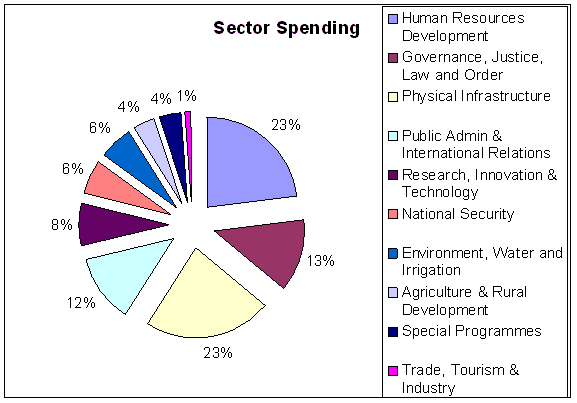
Sector Spending 2011/12

One of the key things that really got my eye is the proposed expenditure. As is the case the usual suspects still get their fair share however the government earned my points on allocating 5.6 Billion to the safety net. Under this it has set out Kshs 1 billion for older persons (people currently highly affected by high cost of living), Kshs 300M for Girl child and my favorite Kshs 845 M for Gunny bag grants for urban poor.
The gunny bags are going to be used in sack gardening in urban slums. These funds will scale up the Urban Food Security Program currently funded by European Commission and AFD in Urban areas of Nairobi, Mombasa and Kisumu.
Irrigation
The government has allocated to spend 6% of its spending on the irrigation. This has been warmly welcomed. The Agricultural Secretary Dr. Songa has noted this will go a long way in what the Ministry has been preaching, water harvesting.

Physical Infrastructure
The government is allocating a big chunk 23% same as that of Human Development on Infrastructure. It would be worth while to know who will be up-scaling/building the urban commuter railway.

Challenges Pointed
Absorption
The government has been shown to have a big problem with its absorption capacity. Kwame Owino the CEO of IEA has pointed out that at the end of the financial year ministries tend to return monies to the ex-chequer (Treasury) due to low absorption capacity in line Ministries.

Graft
It is now emerging that 4.2 billion was misused or ended up to its unintended purposes in the Ministry of Education. This had long been flagged by donor agencies who partnered with government to achieve this noble goal of educating the young citizenry through the Free Primary Education (FPE).
 

Friday, June 3, 2011

Trans-Century at Mind Speak

May’s edition of Mind Speak saw Transcentury parade itself in this monthly forum (which I regularly attend) organised by Aly-Khan Satchu a Financial Analyst who runs rich management

This was coming head over heals of April forum that had President of Uganda H.E. Yoweri Kaguta Museveni as the Guest speaker. What is fascinating about this company is that it is a company founded by 29 prominent personalities. These personalities have been accused of either being too close to the center of power or have used their positions to acquire contracts or use privy info BUT they have defended themselves as people who have acquired their wealth genuinely and in a range of counties in the region.

To pitch for this company Transcentury were; Dr. Gachao Kiuna (CEO) and Yida Kemoli (Head of Finance and Corporate Strategy).

Background of Transcentury
The CEO Dr. Gachao gave us a brief history of this company. It was started by 29 people (all men) who used to meet informally in what in Kenya we call ‘chama’. They all agreed to each contribute Kshs 1 million. So they expect to have an initial capital of Kshs 29 million however they ended raising Kshs 24 Million.

Their initial investment was in South African Breweries which had entered the Kenyan Market in 1998 only to close in 2002 after four-year beer war with Kenya Breweries and failing to secure a 10% of market share.
These investors managed to recoup their investment from SAB due to the fact that SAB pulled of the market by a negotiated settlement with Kenya Breweries Ltd (now East African Breweries Ltd, EABL).

Having learned from this experience the 29 vowed never to go for anything less than controlling stake in a company (51% of the share capital).

Present Day Transcentury
The 29 investors formed Transcentury which is a Holding company with interests in;

  • Power Infrastructure: Manufacture of Electrical Cables, Conductors, Transformers and Switchgear. 
  • Transport Infrastructure: Operation of the Kenya-Uganda Railway Concession.
  • Specialized Engineering: Distribution of Mission-Critical Industrial Equipment and Construction of Electrical Installations.  
The company has pan-African interest in outlook i.e. it wishes to invest in the whole of Africa and that is why as I came to find out it was at the event because it wants to list on the Nairobi Stock Exchange (NSE).

The company has 5 divisions i.e. Power Infrastructure, Transport Infrastructure, Specialized Engineering, Consumer and Affiliated Holdings.

Reservations
The company has raised some eye brows with its Transport Infrastructure division with people questioning the way it got into the concession of Rift Valley Railways (RVR) and the two guest speakers had a hard time convincing us. However, they had their side of the story.
The company seems to hedging on the railway considering it is has entered into partnership with a Brazil Railway company America Latina Logistics (ALL).

The other eye brow is that the company can’t seem to send away the ghosts of the 29 investors who as some would put it could raise the issue of ‘conflict of interest’ given that some of them are CEO’s of some of the divisions the company engages. To this the CEO pointed out that some of their major customers are you and me (ordinary folk) and NOT government parastatals.

The other observable omission in the company which was observed by Gina Din was that the company’s 29 investors are all men!

Going Forward
In the infrastructure sector given that most of the infrastructure building is done by Chinese Companies funded by China gov’t which has shown that it is willing to fund states improve their infrastructure. Does Transcentury know anything that we don’t? (A query raised by one of the participants).

Only time will tell however, should you want to know more about this company the CEO Dr. Gachao Kiuna asked the participants to visit any Dyer & Blair.

Presentation at Mindspeak (Pdf)

Wednesday, April 13, 2011

The Prosecutor ‘Benched’

Those who know me will tell you that I love Capital Talk which airs on K24. Given the number of soaps in our television sets I had turned on to Kiss TV however they re-branded and things got from good to as worse as they could be!  

Hence my love affair with Capital Talk which is brought to our sitting rooms everyday at 8 and 10.30pm by the so able Jeff Koinange (a former CNN Africa reporter). Among the personalities he has interviewed are seating and former head of states, public personalities, businessmen, entrepreneurs and normal Kenyans with extra-ordinary stories to tell.

Last year, I remember Blogging about M. Wrong on the bench (one of my favorite last year not to mention former Nigerian President Olusegun Obasanjo).

This year, I remove my hat to Jeff Koinange and his K24 crew for securing an interview with the International Criminal Court (ICC) prosecutor, Luis Moreno Ocampo.
This was done in the sidelines of the summons of the Ocampo 6 at The Hague i.e. the first week of April 2011.

It was note worthy that Jeff Koinange managed to give us a glimpse of the prosecutor we had NOT seen. The picture of the prosecutor I had observed was the emotionless, no none sense person but we got to know a bit about where he hails from Argentina if you missed. He was the prosecutor of the top military generals who had committed crimes in Argentina when South America competed with Africa in that respect. This story has radically changed with time as a result of good governance. Countries such as Brazil are the engines of economic growth in the world and offer alternative development paradigms.

The prosecutor told as a little bit about his background. His grandfather was a general in the Argentine army and his father a colonel. He also, spoke a bit on his stint as the lead prosecutor in Argentina military trials. He talked about how he was loathed by the whole country (including his own mother!) but later turned to be loved. Talk of being on the right side of history.
He also alluded that he is a man of passion. By this I mean he seeks the things that he has a passion for. Perhaps this can explain the jest in which he takes his work. This is because he has a passion for it!
He also talked of being an optimist. In that he sees the glass half full as opposed to being half empty.

The Prosecutor and Kenya
During the interview the prosecutor was under no illusion that he can single handedly change the country pointing out that as a prosecutor he cannot FIX our country. He did point out that it is up to Kenyan’s to decide who their leaders are and that all he was doing was prosecuting the person’s who had the greatest responsibilities for Post Election Violence (PEV) in 2008. He is doing this under the mandate of the international community. He was however, optimistic that though the ICC process he can contribute in the transformation process of Kenya to become a better country in a ‘small’ way.

Elections in Africa
On the Kenyan case he pointed out that this cases at The Hague are different form other in that this is about a disputed election. Unlike, the Bemba case (DR Congo) and Kony (Northern Uganda) which are about contested spaces (warlords).

Considering there are about 16 elections to be conducted in Africa in 2011-2012. It is imperative the international community gives clear signals that the habits that are synonymous with Africa incumbents of rigging elections and clinging to power are brought to an end.
So this is a chance for Africa to change.

The prosecutor also alluded to the fact that he would like to be invited to witness the swearing in ceremony of the president elected after the 2012 elections.

Kenya and Sovereignty
Some of the people leading for the trial of the so called Ocampo 6 have made their arguments around the issue of sovereignty. Arguing that cases brought to the ICC are for failed states.
In fact, the debate has been so intense as to come to the point of challenging the normal business of NGO’s, civic society and diplomatic mission.

However, when Jeff put this question to the prosecutor he was of the opinion that Kenya will show the world an example of how to go about in terms of a dispute. The prosecutor pointed out that Kenyan’s will come out of this process being winners. 
This is rightly so considering Kenya will be the first nation to question admissibility of the court among the Rome statute signatories.

ICC Cases
The prosecutor alluded to his thoughts and perspective on the cases he is prosecuting. When asked about his thoughts on the PEV cases. At first he thought it was a police operation when the chief mediator Kofi Annan presented him with the ‘Waki’ envelope.

However, the evidence pointed in to two distinct cases. These cases were the people who planned the violence in case of defeat and the people who reacted to the violence. Hence he built his case on this.
It is on his explanations that I fully understood how journalist Sang had come into the picture i.e. attending meetings and giving signal while broadcasting. This is opposed to what I had in mind i.e. propaganda.

When asked if he had any personal vendetta on the suspects he answered on the contrary. He said he did not have any grudge against anyone despite even Mr. Ruto calling the prosecutor ‘an evil man’. He talking of having shaken their hands and that he would be happy if they proved him wrong in court. Eluding to the fact that JUSTICE is NOT about putting people in JAIL. It is about TRUTH.

Retirement Plans
The prosecutor also hinted on his retirement plans given that his term at ICC as a prosecutor comes to an end in 2012. Some of his achievements will be living an institution in place with his office of 300 staff.
He pointed out that he could retire to Harvard.

However, in the mean time he is looking forward to great legal debates in court. Given the suspects have very good defense councils. 

Tuesday, April 12, 2011

The ICC Process and Kenya

Background
April was a month where all of us (Kenyan’s) were looking at The Hague. This was as a result of being bombarded with news of Ocampo 6 and their scheduled trip to The Hague. For those without a clue on what the phrase Ocampo 6 means. This are the 6 individuals that the Prosecutor of the International Criminal Court, ICC Mr. Louis Moreno Ocampo perceived to have the most to answer about the post election violence that grappled Kenya after the bungled polls of December 2007.

All of us saw on the television sets in early January 2008 as a Kenya almost went to the dogs as the two feuding parties ODM and PNU tried to settle their scores outside the ballot. It had to take the intervention of seasoned diplomat Kofi Annan, the immediate former UN Secretary General for cessation of hostilities between the two groups and the formation of a coalition government to take us through until 2012.

Under this process 4 agenda’s were agreed with the first being the cessation of hostilities and formation of a coalition government. Others were formation of Judge Waki and Kreigler commissions with the former required to look at the persons responsible for the injustices and the latter to determine what went wrong in the election process. Both this commissions gave their finding known with Waki commission and Kreigler commissions presenting their finding to the two principles. The Kreigler commission went to as far as to say it was impossible to determine the clear winner in the 2007 polls while the Waki commission presented a secret envelope to the chief mediator Kofi Annan. The suspects in the Waki envelope were to be either tried locally or taken through an international process. The other agenda was the enactment of a new constitution which is already in place.

International Criminal Court
In mid December 2010 the Prosecutor announces the 6 suspects that in his opinion bear the greatest responsibilities for the Post Election Violence and the death of over 1000 people and displacement of over 100,000 persons internally. The 6 suspects were William Ruto (then Minister of Higher Education), Uhuru Kenyatta (Dep. PM and Minister of Finance), Francis Muthaura (Head of Civil Service), Henry Kosgey (then Industrialization Minister and head of ODM), Maj. Gen. Hussein Ali (Post Master General and former head of Police) and Sang (a little known journalist).

The announcement of this names sent shock waves to the highest echelons of the Kenyan government. Since most of the parliamentarians when presented with a local judiciary mechanism thought that the ICC would never come calling in and ‘IF’ it did the it would take ‘light years’ for the process to commence. Furthermore, most were of the opinion that the Waki envelope did not contain their names and at most the responsibilities of Post Election Violence would be weighed by the principals.

However, the prosecutor had pulled a fast one on them! He was not going after ‘Political Responsibility’. He was going after those who planned attacks in certain parts of the country and executed those plans. He was also going for the jugular of the people who responded to these attacks by organizing counter attacks.

The Administration hits backs!
When it clearly sunk in to one part of the coalition government that The Hague process was NOT vague as had earlier been assumed. That part of the coalition started to plan a counter offensive to this route.

This came through the botched appointment of Chief Justice. An episode that saw the president ‘eat’ humble pie by taking back four constitutional nominations. This was done early in February 2011 before a scheduled AU head of state conference. This episode almost saw the split of the coalition.

The other was through the infamous ‘shuttle diplomacy’. The vice President of the Republic flew on the tab of tax payers to different capitals of the world to woo major players in the world to support an AU sponsored motion to deferrer the ICC case for 1 year on account of expected election in 2012.

When the shuttle diplomacy hit a snag the government went to the last option of contesting jurisdiction of the Post Election Violence cases at the ICC.

Perhaps it is on this account the prosecutor instigated early summons of the suspects to the ICC on April 6-7, 2011.

Count Down to The Hague
As the D-Day approached 4 of the Ocampo 6 engaged in a series of Public rallies and cum Prayer meetings. Perhaps when it dawned on them that The Hague had become inevitable.
However, some of these rallies had what Judge Ekaterina Trendafilova called ‘dangerous speeches’ that could see the recurrence of violence.

As The Hague date approached the government became disorganized in terms of the approach to take to save the six high level persons.

However, what came as a shocker was that 40 MP’s were accompanying the six to The Hague.

D-Day I (April 6, 2011)
This was the fist we were seeing of the ICC in action. On this day saw the appearance of William Ruto, Henry Kosgey and Sang at the ICC chamber 2.

What stood out for me was the sheer timeliness (the three were warned for 3 minutes delay) efficiency and clarity of the court.
We also got to know the defence council of the suspects, the court registry, the prosecutor team and the judges.

We also witnessed drama and side shows of Kenyan MP’s who accompanied the 6 to The Hague. (Mind you most of the TV station had crew at The Hague reporting LIVE!). This lead to a joke of Nation TV was doing county edition aka Hague County (48th County)!

D-Day II (April 7, 2011)
On day 2 of the ICC we saw the defence council of the other 3 suspects. However, saddened to learn this group (nick-named by the Kenyan Press-All the Presidents Men!) had few if none Kenyan’s in their defense council.

Reflections/Questions Arising
Now that we have a Hague process going on it is time to have a local mechanism to try the ground soldiers of the post election violence. To out as one member of Bunge la Mwananchi put it. The Hague Process is like a rabbit it would be over without us knowing it serving a Western kind of Justice. We need a Tortoise mechanisms which will lead to trying of small perpetrators which will take time become an example to local folk not to be used and misused.

We need to know what the government was conceding during the negotiation for so called shuttle diplomacy. Something MUST give and the public ought to be informed on concessions made for support of Kenyan deferral at the UN Security Council.

A mechanism needs to be adopted for future shuttle diplomacy mission. A clear guideline should be tabled and at first instance diplomatic missions in the country need to be the first reference points for such endeavors.

Thursday, March 17, 2011

Walking Nation

Everyone’s lips are fixated to the rising cost of living that we are experiencing in this country. A lot of this has to do with rising cost of petroleum products which have hit 3 digits from Kshs ninety something to over a hundred Kenya Shillings. To add insult to injury the country may be experiencing another drought. From where I sit the government has been requesting a report on the impact of drought on food prices.

However, what you don’t fail to notice while coming to work or going home is the sheer number of persons who are walking to and from work. So one has to ask has this country become Cuba or is it under an embago of sorts?

I was fortunate enough to attend a public forum organised by the Institute of Economic Affairs (IEA-Kenya) which centered on effects of petroleum pricing regulations in Kenya.
Members/ speakers presents were cross cutting along the value chain of petroleum products from middle boys of the industry i.e. Petroleum Institute of East Africa (PIEA), regulators i.e. Energy Regulatory Commission (ERC), independent petroleum suppliers and consumers/consumer organization i.e. the Consumer Federation of Kenya (COFEK).

MIA were the big industrial players (BP, NOC, etc) nevertheless, one was able to get a picture on how the industry operates. Perhaps of interest to every one present was how the ERC was going about its business of setting up prices of petroleum products.
One of the things to note is that ERC mandate to control prices came into force in December 15, 2010. However, since its mandate came into operation people presents were of the view that they have not experienced an adjustment of prices downwards. The ERC was of the opinion it is too early to start judging its performance.

During the Q&A session we wanted to know how pump prices were arrived at and from the pump prices in early December of Kshs 91. Here is the breakdown;


 Kshs
KShs
%
Landing Price Mombasa

49

Taxes

29.85
60%
Margins (Marketers)
6


(Retailers)
3


9
11%
Transport

4
5%
Total

91.85


From the above you will notice the government gets a huge chunk in taxation. So the question is if the treasury would reduce the amount of taxation?
Well, the treasury according to ERC officials present pointed out that it would want to know where it can recover that amount from!

From my own perspective I tend to think that should this continue (Read: Drought, floods and food. An opinion piece from Paul Krugman) then come 2012 a lot of legislators are going home or anything in between is anyone’s guess!
Presentations:
Energy Regulation Commission Presentation: Examining the Rationale & Effects of Petroleum Pricing Regulation in Kenya (Part 1 and Part 2)