The tiger doesn't shout about his tigritude. You see the skeleton of an antelope and you know that some tigritude has emanated.
Tuesday, October 19, 2010

Thursday, October 14, 2010
Delivering Aid Differently: Lessons from the Field
 |
| Book Cover |
This book argues the 200 billion dollar aid industry faces new realities from the tradition model of development assistance. What makes this book fascinating is that the author’s backgrounds i.e. Dr Wolfgang Fengler is the World Bank's lead economist in Kenya and Homi Kharas is a scholar based at the Brooking Institution* in Washington D.C.
The book has contributions from all over the place which makes it admirable that the World Bank boys sought collaboration from their African counterparts. The World Bank country Johannes Zutt did make it clear that this book is NOT a World Bank publication BUT nevertheless it offered new insights both to him and the Bank.
Other Scholars that contribute to this book include; Cut Dian Agustina (World Bank), Getnet Alemu (College of Development Studies, Addis Ababa University), Rustam Aminjanov (NAMO Consulting), Ek Chanboreth and Sok Hach (Economic Institute of Cambodia), Firuz Kataev and Matin Kholmatov (NAMO Consulting), Johannes F. Linn (Wolfensohn Center for Development at Brookings), Abdul Malik (World Bank, South Asia), Harry Masyrafah and Jock M. J. A. McKeon (World Bank, Aceh), Francis M. Mwega (Department of Economics, University of Nairobi), Rebecca Winthrop (Center for Universal Education at Brookings), Ahmad Zaki Fahmi (World Bank)
Book Overview
The book has ten chapters which contain six country case studies. These are;
- Aceh (
The book has three thematic chapters. These are;
- Joint Assistance Strategies,
- Information Systems, and
- Humanitarian Aid
NB: All country case studies written by scholars of aid-recipient countries.
Reviews of this book
"Can aid deliver the economic, social, and political transformations development demands, or is it condemned to small successes and failures? This is the central question that Wolfgang Fengler and Homi Kharas take on. Their approach is novel: to elicit the answers from scholars from the aid-recipient countries themselves. I commend this book to all those interested in reforming how aid is delivered so that it eventually becomes redundant."—Ngozi Okonjo-Iweala, Managing Director, The World Bank, and former Minister of Finance , Nigeria
"This book highlights the problems faced by recipient countries in prioritizing and managing aid receipts. Its recommendation to strengthen and differentiate aid coordination and management at the recipient country level is very appropriate. Both development partners and recipient countries need a constructive discussion; and hearing the aid recipients can yield crucial insights."—Farrukh Khamraliev, Minister of Economic Development and Trade , Tajikistan
Book Launch
The book was launched at University of Nairobi
The dean faculty of arts, Prof. Njeru introduced us to the university and afterwards the World Bank Country Director Johannes Zutt had a few words. It is at this juncture he highlighted that this publication is not a World Bank publication. The director did point out that this publication was important since it gives the Bank new insights into this important field.
Dr. Wolfgang Fengler made his presentation which was very insightful. (Can download the presentation on this site
Some of the highlights for me in this presentation were;
- Aid Can Work. From the Marshall Plan in Europe after World War II to M-PESA in
- The New Reality of Aid. The number of new players has increased rapidly and the demands of clients have differentiated. New players have brought fresh energy and approaches to the delivery of aid. But they have also added to fragmentation and volatility.
 |
| The old reality of aid |
 |
| The new reality of aid |
The new aid architecture
- Demand Differentiation-A wide spectrum of clients: Fragile states, MICs, small states, etc
- Diversity of Donors-Traditional donors, “New Bilaterals”, NGOs
- Dynamics of Development-Innovation, Information, Evaluation, Scaling up
 |
| The total no of projects has quadrupled while the average size declined sharply (ODA only) |
 |
| ...and new players have added to increased Fragmentation (A case study of Aceh-Indonesia) |
 |
| Aid to Kenya has been declining until recently...(Case Study Kenya 1981-2006) |
 |
| ... and donor funding has become increasingly unpredictable (Case study Kenya 1981-2006) |
- Delivering Aid Differently. Filling gaps is not sufficient. Today, aid needs to leverage knowledge, the hardest currency of the 21st century, to evaluate programs, identify success, and then scale up.
Summary

After the presentation there was an interesting panel discussion which was moderated by Prof. Michael Chege. The panel consisted of;
- Dr. Wolfgang Fengler (author)
- Dr. Kamau Thuge, economic secretary (representing the PS Treasury Joseph Kinyua)
- Dr. Richard Leakey
- Johannes Zutt (World Bank Country Director)
Among the things that emerged were the contentions of conditionality that the WB pegs to funding projects. Other issue addressed from the government side was the desire for consultation and fact checking before going to some civic societies.
Also Dr. Leakey advocated on the need for the WB to reconsider its aid dispensation. Perhaps, it should link up with Commercial Banks to facilitate low interest loans borrowing
Additional Information on the Authors
Wolfgang Fengler
 |
| Dr. Wolfgang Fengler |
Education
Graduated from German Universities in 1996 (Masters) and 2000 (PhD)
Career history
Founded a number of companies, including Africa Consulting in the 1990’s
Left Germany and joined the World Bank in January 2000
Became Senior Economist for the World Bank in Indonesia in 2004
Moved to Kenya as World Bank Lead Economist in August 2009
Left Germany and joined the World Bank in January 2000
Became Senior Economist for the World Bank in Indonesia in 2004
Moved to Kenya as World Bank Lead Economist in August 2009
For more than five years he lived with his wife and three small children in Indonesia
While in Indonesia
Prior to joining the World Bank, he was a Fellow at the Research Institute for International Relations (now in Berlin
Wolfgang loves ping-pong and tries to play every Friday afternoon with the drivers and security guards in one of the Bank’s conference rooms. He was also part of the World Bank Jakarta soccer team and intends to continue his sports activities in Kenya
 |
| Homi Kharas |
Notes
* The Brookings Institution is a non profit public policy organization based in Washington , D.C.
Wednesday, October 13, 2010
It is our turn to blog!
Michela Wrong the author of 'it's our turn to eat' was in town. She was around purposely for the Story Moja Hay Festival (so me thinks) since she was a key speaker in two events there. Where I also got the rare chance to hear her speak mostly about corruption culture in Kenya and what she is up to. Sorry, she is not writing a book about Kenya!
So I also got to catch her on Capital talk with Jeff Kionange whom they go way back. So below are clips of M. Wrong who got some things right about Kenya.
Some of the things on this clips are;
Bonus: Michela Wrong on Kenyan corruption and tragedy of post-colonialAfrica
So I also got to catch her on Capital talk with Jeff Kionange whom they go way back. So below are clips of M. Wrong who got some things right about Kenya.
Some of the things on this clips are;
- Her thoughts on impunity and ICC process
- Problem of it’s our turn to eat philosophy in Kenya
- What she is up to i.e.writing fiction and things to do with hope
Ps: Ignore the introduction by Jeff Kionange!
Bonus: Michela Wrong on Kenyan corruption and tragedy of post-colonial
Tuesday, October 12, 2010
Jukwaani!

Jukwaani! Which is a project organised by Goethe-Institut (German's) and Alliance Française (French) was here with us again for the second time. This festival which incorporates spoken word, poetry, mashairi, story telling, hip hop and other forms of performance art took place towards the end of September. September 24-26 to be precise.
I attended the opening ceremony on Friday 24th at Goethe Institut albeit late but in time for the panel discussion on Swahili poetry. This session was titled; 'USHAIRI WA
- Prof. Rocha Chimerah (Pwani University, Kilifi) ‘The classical poetry of Muyaka wa Haji’
- Prof. Ahmed Nabhany (RISSEA, Mombasa) ‘The different types of Swahili poetry’
- Dr. Edwin Masinde (Kenyatta University) ‘Wrestling with the past: Debate about Swahili Poetry and its form’
- Prof. Clara Momanyi (Catholic University) ‘The poetry of Shaaban Robert’
Thereafter, the Swahili scholars got to do what they love most, talking about Swahili in Swahili.
Prof. Rocha gave us abit of history into the life of Muyaka and the impact that he had on swahili poetry. Muyaka is credited with moving swahili poetry from the mosque to the market place.
Prof. Ahmed who is at the Research Institute of Swahili Studies of EasternAfrica gave a rundown of the different types of Swahili Poetry and discarded the myth that all swahili poetry is known as Mashairi.
Prof. Ahmed who is at the Research Institute of Swahili Studies of Eastern
Prof. Clara Momanyi talked in length about the poetry of Shaabani Robert. In there she picked some wisdom from Shaabani Robert for the ladies on how to keep their guys! She also talked about the poet himself and the research she was conducting on him.
Amira Said closed the session with her poetic piece in praise of the organisers of the event.
Thereafter, Prof. Kimani Njogu entertained some few questions and insights from the audience so that the discourse was not a one sided affair. What I noted from this session is that Kiswahili is now the 1st official language followed by English according to the new constitution. (Perhaps, I should start blogging in Swahili!).
Also, the Swahili linguist were in good moods since they had been pushing for this for a long time. I believe Twaweza communication was in the forefront of pushing for this when views were been collected on the new constitution
Official opening followed this session at around half past six. The Ambassador of France, Mrs. Elisabeth Barbier (outgoing French envoy) and the Head of Press and Cultural Affairs at the German Embassy in Kenya (in her first public event. She was posted to the country recently. Mind you the lady already knew some Swahili) were there to open the festival. They encouraged us to embrace and use Kiswahili.
 |
| 2010 Jukwaani! Poster |
It would also be worthwhile to note Radio France International (RFI) has started to broadcast in Swahili.
Once the festival was officially opened we moved to Alliance Francaise for the cocktail reception. Obviously, one has to enjoy how the French and Germans know to treat us. The cocktail was at the Alliance Francaise garden.
Once the festival was officially opened we moved to Alliance Francaise for the cocktail reception. Obviously, one has to enjoy how the French and Germans know to treat us. The cocktail was at the Alliance Francaise garden.
 |
| Mwana Mdogo wa Mfalme |
After the cocktails, we went into the auditorium for play, Mwana Mdogo wa Mfalme (The little Prince). Translated from the famous work of Antoine de Saint-Exupery, 'The Little Prince' is a classic tale of equal appeal to children and adults and the A/F director noted it is very popular in France in her remarks before the play started.
On one hand, Mwana Mdogo wa Mfalme (The little Prince) is the story of an airman's discovery in the desert of a small boy from another planet- the little prince and his stories of intergalactic travel. while on the other hand it is a thought- provoking allegory of the human condition. mind you some of the scene's was customized into the Kenyan environment.
This play marked the end of the first day of the festival and a Friday well spent in Nairobi.
This play marked the end of the first day of the festival and a Friday well spent in Nairobi.
Jukwaani! is a joint initiative supported by the special fund for cultural projects established by the Ministries of Foreign Affairs of both France and Germany
Links
Jukwaani Website
Links
Jukwaani Website
Wednesday, October 6, 2010
SAMOSA Festival
SAMOSA Festival is billed as a festival of cross cultural interaction in Kenya
Samosa festival is a biannual event and the organisers believe that art, music, dance and poetry are some of the easiest and most expansive ways for humanity to embrace diversity.
Samosa is a name of a Swahili dish that uses many ingredients to prepare and so the name Samosa Festival
The organisers of 2010 SAMOSA Festival were mashing up the nyatiti with the sitar, putting together Rangoli with bottle tops and tile chips; having Zulu and Indian dancers stamp their feet to the same rhythm; and having poets sketch with words, as artists weave with pens; asking
What does it mean to be Kenyan in Kenya
The tag line for this festival was "Different is Exciting."
The events that I managed to attend we two out a week long of activities. These are the play My Moving Home and A Panel Discussion on Cohesion & Ethnicity
- My Moving Home
My Moving Home is a play by 'T
he Theatre Company' which is a stage performance inspired by Rogers Otieno’s tough past in rural Nyanza, and first love in My Moving Home by Rogers Otieno
DURATION: 1 hour 10 minutes
CAST: 4 actors, 1 Musician
SYNOPSIS: A story inspired by the upbringing of Rogers Donatus Otieno who moved form his grandparents’ rural home to the urban community of Eastlands,Nairobi Rogers
LANGUAGE: Swahili/ Sheng/ English.
STYLE: Dramatic Musical & Narration
DURATION: 1 hour 10 minutes
CAST: 4 actors, 1 Musician
SYNOPSIS: A story inspired by the upbringing of Rogers Donatus Otieno who moved form his grandparents’ rural home to the urban community of Eastlands,
LANGUAGE: Swahili/ Sheng/ English.
STYLE: Dramatic Musical & Narration
- A Panel Discussion on Cohesion and Ethnicity
The Organizers of Samosa wanted to know;
WHO IS A KENYAN?
From Perspectives of Culture and Arts , History, Identity, Politics and Economics , Values and Socialization.
Panelists: Alice Nderitu, Julie Gichuru, Keith Pearson, Ngunjiri Wambugu, Dr. Rafique Keshavjee and Tazim Elkington
Alice Nderitu
Julie Gichuru (Moderated the debate)
Julie is a renown TV personality and a leading news anchor who is great with TV interviews. Julie is responsible for spearheading the move towards establishing a global presence through the internet and raising revenue through digital platforms. Julie is the first African woman to receive the Martin Luther King Salute to Greatness Award for Advocacy of Active Non-Violence and Peace during the post-election violence in Kenya
Keith Pearson
Keith Pearson is The Managing Director of ‘The Theatre Company’. He is a man of many talents. Arriving in Nairobi in 1979 to teach English, Keith made Kenya Nairobi
Ngunjiri Wambugu
Ngunjiri is the CEO of Ngunjiri Management Co. (a concepts development consultancy), the Executive Director of Change Associates Trust & Convener of Kikuyusforchange. He is a social justice activist and has been in the forefront of advocating and agitating for national reconciliation and peace.
Dr. Rafiq Keshavjee
The Head of Academic Planning for the Faculty of Arts and Sciences in East Africa is responsible to develop the academic vision and framework for the Faculty. The Head leads a team of curriculum designers to develop a detailed curriculum plan and also inform key issues in the design and set-up of the FAS. Dr Rafique holds a PhD in Anthropology and Middle Eastern Studies from Harvard University
Tazim Elkington
Tazim Elkington is the embodiment or living example of an inspiring and authentic life being lived. Tazim has a mission to bring about change in society. Her compassion extends from the individual, to groups of people, businesses and KENYA
- The SAMOSA Festival Programme was as follows:-

TRIBANGHI DANCE THEATRE
SAT 18 SEP │7.30PM│ALLIANCE FRANCAISE GARDEN │KSHS 1,000
SAMOSA FILM SCREENINGS
SAT 18 - SUN 25 SEP │MATHARE │FREE
MOVING HOME – A THEATRE COMPANY PRODUCTION
SUN 19 SEP │7.30PM │ALLIANCE FRANCAISE AUDITORIUM │FREE
KENYAN RANGOLI
MON 20 - SAT 25 SEP │RAMOMA ART GALLERY │FREE
TRIBANGHI DANCE THEATRE
MON 20 SEP │8.30PM│LOUIS LEAKEY AUDITORIUM, NATIONAL MUSEUM OF KENYA │ KSHS 1,000
A DISCUSSION PANEL ON COHESION AND ETHNICITY
TUE 21 SEP │ 6.30PM │ ITALIAN INSTITUTE FOR CULTURE │FREE
SAMOSA KIDS
TUE 21 - WED 22 SEP │BROOKHOUSE SCHOOL │INVITE ONLY
SAMOSA MENTORSHIP PROGRAM LAUNCH & COCKTAIL
WED 22 SEP │ 4PM │ HALL OF KENYA, NATIONAL MUSEUM │ INVITE ONLY
PERFORMANCE POETRY
THUR 23 SEP │ 6.30PM │ ALLIANCE FRANCAISE AUDITORIUM │KSHS 200
CONCERT UNDER THE STARS – AN EXPLOSION OF KENYAN FUSION
FRI 24 SEP │ 8PM │ COURTYARD, NATIONAL MUSEUM OF KENYA │ KSHS 750
SAMOSA SPORTS
SAT 25 SEP │ 10AM │ NAIROBI GYMKHANA │ FREE
Story Moja Hay Festival
Friday 1st October 2010
On Fridays I attend British Councils Creative Enterprise Programme and since the Council is one of the major/global partners of the Story Moja Hay Festival we are reliably informed that there is no class in the afternoon (Hooray!). We are to prepare ourselves to attend the festival. In particular, we are to attend the British Council lecture series on creative industries.
After lunch we walk to Nairobi Railways ground the venue of the festival and by 1500 hrs and we are sitted in the British Council Marquee where a creative enterprise panel made up of environmental entrepreneur Andy Middleton, novelist Tiffany Murray, Julie Grigg and moderated by Anita Sethi (Journalist) is almost winding up its discussion.
However, I manage to get a few insights from the debate. Especially, how successful the UK
Thereafter, a discussion between the audience and the panel ensues and Andy passes his notebook for contacts so as to continue the discussion.
I take a walk around the tents and discover that there are few people than I had anticipated. This could be attributed to the fact that perhaps guys are still at work. However, going by what we know is that the most Kenyan’s are not into books and by the same breath the pubs would be full come 1701hrs. That explains why poetry is so doing so well of late. This is because the poets have discovered where to find people and bar owners have reciprocated because the patrons enjoy the pieces!
At 1600hrs I head back to the British Council Marquee where Benjamin Zephaniah is to perform some of his works and talk to Anita Sethi the journalist. I had been informed by a friend to look out for Benjamin Zephaniah and boy did he bring the house down…Oops tent!
 |
| Benjamin Zephaniah |
Benjamin Zephaniah serenaded us with some of his poems for about ¾ of an hour. Some of his poems we got to hear are; black consciousness poems white-comedy, Love poem I love my mother and a get real poem wrong radio station (video ), Man to man (about macho man) and one of his commissioned poem London London he informed us that he had been commissioned by the London
Thereafter, he sat down for a conversation with Anita Sethi. It is in these conversations I got to know he had rejected his OBE from the queen and had convinced another recipient to return their OBE on live television.
Benjamin also got political at times. Knowing this is where the US US
He also talked about the Iron lady (Margaret Thatcher) times. How it was offensive to talk about black coffee so as not to offend the blacks within the British society under the banner of ‘race relations’. While, at the same time the conservative government maintained deals will the apartheid regime in South Africa
To crown it all Benjamin talked partly about his experiences growing up, his turning point and encouraged the young lad’s presents not to despair in life. Asked what kept him such a strong performer on stage. His reply was ‘I don’t eat meat, I run and I do not have a girlfriend’
At 1800hrs I was pretty much done with the first day of the festival.
Some of Benjamin's Poetry;
Saturday 2nd October 2010
I made my way to the venue of Story Moja Hay festival (Railway grounds) for the second day this event was going down. I arrived at 1145hrs just in time to catch the British High Commissioner, Rob Macaire leading a discussion on Muslim in Kenya and Muslim in the UK
The High Commissioner had an eminent panel made up of Ahmednasir Abdullahi former Law Society of Kenya (LSK) chair and Hassan Ole Naado, CEO of Kenya Muslim Youth Alliance.
The High Commissioner began by giving a brief background of who he is. Pointing out that he is a professional diplomat who has served his country in Romania , US and his last posting was India India Middle East complex political situation so he is no push over (I respect those guys who have put their fingers on the line for the never unending problems of this region).
 |
| The High Commissioner with his eminent panel |
So having done what diplomats do, he let the other members of the panel introduced themselves. Starting with, Mr. Ahmednasir Abdullahi who is a lawyer by profession. He practices in the city under Ahmednasir Abdikadir & Co. Advocates and pens down opinions for the Nation newspapers. The other member of the panel was Hassan Ole Naado who is the CEO of Kenya Muslim Youth Alliance.
So the High Commissioner kicked off the debate with his own account of ‘Muslims in Britain
So how have Muslim population changed the UK
Muslims have changed the Britain
- Food
- Academia
Muslim Statistics have also had an impact on;
- Unemployment
- Isolation
- Education
The above three issues being major issues in the UK
So this has necessitated the UK government to begin interactions with the Muslim community in the UK
· development of extremism and
· terrorism
The High commissioner finished his account of ‘Muslims in the UK
The ‘Clash of Civilizations’ is a theory, which was proposed by political scientist Samuel P. Huntington after the end of the cold war. In his theory he argued that with the end of Cold War, Civilizations were bound to clash based on their cultures and religions i.e. Christians vs. Muslims.
 |
| Clash of Civilization? |
Hassan Ole Naado began the Muslims in Kenya debate by pointing out that Muslims were among the first foreigners to settle on the Kenyan coast and brought with them civilization. He also posed why most Muslims live mainly in Majengo.
According to Hassan, the Muslims were late entrants into the civic society movements in Kenya
Some of the major issues faced by the Muslim youths in Kenya
- Intimidation from government security agencies
- Foreign policies also affect the Muslim youths in
- Neighboring countries such as
Hassan also pointed he does not buy the clash of civilization theory but stands at the point of ‘dialogue among civilizations’.
Mr. Ahmednasir Abdullahi began this discourse at hand by pointing out that in a BBC interview a former Prime Minister of Malaysia was asked if he was a ‘fundamentalist’. Well, his reply was that he is a fundamentalist of his religion NOT a fanatic.
Ahmednasir further pointed out that Muslims are normally contested on how they observe their religion. However, he pointed out that most liberal democracies especially in Europe allow Muslims to practice their faith.
He also noted that the standard system in UK is adorable unlike French, Spain or Belgium America
Noting this, Ahmednasir emphasized on need to use appropriate venues for Muslims to ask for their rights.
Ahmednasir also alluded to the fact that good constitutions do not make good countries BUT it is the courts that make sure that a good constitution is implemented to the letter.
In the question and answer session the British High Commissioner alluded on the need not to confuse religious issues to political issues
The High Commissioner noted that the Somalia
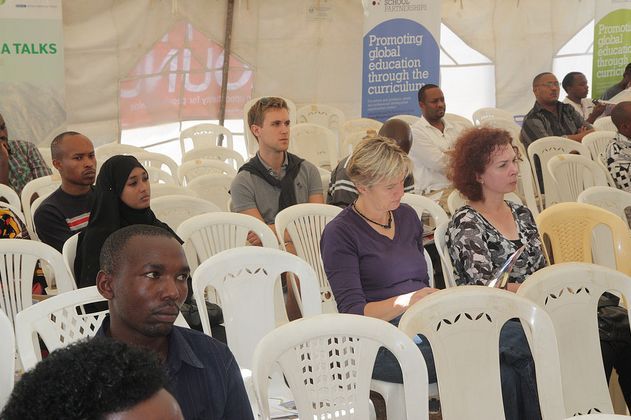 |
| Eminent audience |
NB: For you bloggers out there it would be worthwhile for you to note that the High Commissioner does indeed blog. You can catch here: Rob Macaire blog
Also, Story Moja/Hay Festival British Council Marquee photo stream
Also, Story Moja/Hay Festival British Council Marquee photo stream
In the afternoon (1400hrs-1530hrs) I attended the AfriCOG Marquee which was having a session on ‘whistle blowers’. This Panel was composed of Michela Wrong and Judy Kibinge. This session was moderated by Rasna Warah
 |
| M. Wrong |
This seemed to have been the session everyone was waiting going by the numbers that were at AfriCOG Marquee. Everyone wanted to hear from Michela Wrong who got everything write on Kenya
So both Michaela and Judy Kibinge were provided with opportune moments i.e. John Githogo (former PS Governance& Ethics) arriving in London and seeking a place to stay while for Judy it was the tenth anniversary of Transparency International (TI).
M. Wrong also pointed out that she came to Kenya
In the question and answer session, Lee B. the deputy chief of Staff US embassy in Kenya
In the evening session 1600-1800hrs I was all over the place. However, I cooled my heels by watching a play my moving home at the Kenya Buzz Marquee. Thereafter, I called it a day.
Sunday 3rd October 2010
On the third and final day of the Story Moja Hay festival I attended;
The British Council Marquee: Hay on Earth-Future Scenario’s. This discourse was lead by Andy Middleton and Anjali Saini.
Among the issues discussed here were getting the product right before taking it to the market as opposed to what happens i.e. the reverse!
Andy Middleton talked about innovations especially in tourism circles. A case in point is innovation in Wales
Andy Middleton also talked on how technology platforms can be used to bring people together to make things cheaper. A good example is in the design of cars. Technology platforms have been used to design cars at a much lower price and the end product is far much better as opposed to current models.
Andy also talked of how they have created a club called Club 1. Club 1 goal is to plough 1% of all the revenues of a company or 2.5 working days to charity. Through such endeavors it is possible to change the way the planet looks like.
Anjali Saini talked of eco-tourism. She had been involved in a venture to rate tourist resorts in terms of how best they were eco-friendly. The resorts had not changed with the times BUT are now forced by operators from Europe to be rated so that they can conduct business with them. A classic case of change from the top as opposed from the bottom!
We the audience also participated in the thought provoking debate.
One of the resolutions of attending this discourse was to travel widely in my country.
In the Afternoon I visited the Tandaa ICT Board Tent where Al Kags and Jane Delorie lead a discussion on the Colour of philanthropy.
Al Kags took us through the procedure KCDF goes through in setting up a community project. This procedure involves;
- A discussion with the community on the problems they have as opposed to implementing a project without getting the opinions of the community
- Asking the community why they have not done the said project
- Asking the community what it can contribute ‘if’ KCDF was to assist them to implement the project
- Getting an expert to the community to enrich the discussion at the community level and to better inform the community
- Getting the community to contribute to the project through fund raising, housing the experts during the implementation of the project. Thus, keeping to a bare minimum.
- Getting to know how the community will look after a project once complete
Afterwards we had a though provoking discussion lead by Al Kags who fronted this question. How come not many Kenyan’s contribute to charity?
At 1600hrs I headed back to the British Council Marquee for ‘Verse of Fire’. This was a conversation with poets; Benjamin Zephaniah, Tony Mochama, Njeri Wangari and moderated by Kerugo Macharia.
This was a thought provoking session and we got to enjoy more poetry from the entire panelist who recited their works.
Thereafter, I got to attend the US Embassy Stage where I was able to catch some story telling extravaganza from Mshai Mwagola, Eric Omondi and Moses the winner of the Story telling competition.
Bottom Line:
Story Moja Hay Festival is a good thing we have and I hope Kenyan people will get to appreciate it. To quote the US Ambassador, 'this was a festival of the mind and soul'.
I had myself a good time and I look forward to next year’s festival.
I had myself a good time and I look forward to next year’s festival.
Thursday, September 30, 2010
Tuesday, September 28, 2010
TEDx Nairobi
Having NOT secured a Ticket for the TEDx event earlier (since the event had been SOLD OUT way long before I came to get wind of it!). So, I made my way to the venue early and I camped there hoping for a Miracle happen! And boy it did happen.
Being among the first, I got myself busy by getting checked up by Resolution Health one of the sponsors of the event who had set up tent outside the Louis Leakey Auditorium for guys like us. They checked my blood pressure, blood sugar, BMI, etc. I can comfortably disclose that they found me as fit as a fiddle.

Kenya
The event came to an end with an introduction of the organisers and a performance by the Akala band.
* Photos from: Zulu Safari
At around 12.50pm guys started streaming in and I got to mingle with some friends and guys that I know from the Internet sphere.
So what is TEDx? And what (no) good are they up to?
TED means: Technology, Entertainment, Design. Their tagline is; ‘Ideas worth Sharing’.
However, TEDx is an independently organized TED event.
Inside the Louis Leakey Auditorium. Everything was arranged into perfect symmetry with symmetry here signifying order and had that Africa feeling to it more like those reality series held outdoors (Does survivor Africa rings a bell here?)
 |
| Masaai Painting |
 |
| Fit for king |
 |
| Side view of the stage |
 |
| Audience view |
Juliana Rotich the MC for the day was there to welcome us (Well, I managed to get into the event because some guys who had secured tickets had other engagements to attend) us at 1400hrs and give us the house rules of TED events.
The theme for this event was ‘Green City in the Sun’ which was Nairobi Kenya
The first speaker of the day was Su Kahumbu of Green Dreams which is a company that deals in organic farm produce. She was talking about the need to eat the right foods while also conserving the environment. She pointed out that the food in Nairobi
 |
| Wycliffe Sande during his presentation |
Wycliffe Sande, one of the organisers of TEDxKibera was the next speaker. He talked a bit about Voice of Kibera which is used to get information on Kibera. It works in a simple way in that once can send an SMS and tag it with Kibera which will then be picked up and used to display the information on Kibera. Wycliffe also added that they had so far received 309 reports from reliable sources & 30 SMS plus 8 e-mails during referendum days using the Voice of Kibera network.
The third speaker was Kenya Nairobi ’s Nairobi River Nairobi Nairobi
 |
| Jon Bohmer |
Next up was Jon Bohmer, a Norwegian inventor based in Kenya Kenya
 |
| Kyoto cooking box for you |
260mn tons of plastic per year are disposed and this is increasing exponentially.
The world’s poorest nations have the largest land masses and the most sun (Africa )
 |
| Kyoto box explained. NB: Notice the solar torch by his waist |
The Kyoto Box can also show when the water is already clean by use of a special filter. Other products that are made by Kyoto Energy are:
Turbo is a stove that is made locally by artisans and is energy efficient.
Butterfly is a plastic solar concentrator. It is quite low cost (25% PV). He is also working on a project of utilizing Butterfly which will be set-up in Naivasha.
Cocoon is an algae photo bi-reactor that can be used to grow food.
Hippo Roller can be used for getting water from the river instead of carrying it in jerry cans.
Kyoto Pump used to pump water and can be used either manually or with electricity.
He is also finalizing plans to set up ‘the Kyoto Institute’ which will be setup in Narok University College
(After this: I think with the current constitution we should give some of those Norwegian Folks Citizenship based on such SMOKING HOT IDEAS!)
Njeri Wangari aka Kenyan Poet, was next on stage. Wangari Njeri is also an author with a book to her name, Mines and Mind Fields which is a poetry book.
She recited a soulful poetry piece on urbanization and its impact on the environment. Mind you the Chinese are constructing some super roads and next to the venue they were doing their thing!
 |
| Eric Kigada making his presentation. Sadly KPLC was there to show us the other side of light |
Eric Kigada, an architect with Planning Systems and Services talked on ‘sustainable cities’. His company has worked on various buildings in Kenya , factories and also other projects in Africa . Nairobi was Kenya Nairobi had also been envisioned to grow towards Thika and not Athi River Nairobi Nairobi ’s metropolitan plan hopes that by 2030 Nairobi Nairobi Nairobi
 |
| Rabia |
Rabia who is a radio presenter with Nairobi
 |
| Rabia |
John Kasaona’s talk on conservation and nature that he gave at the Feb 2010 TED event in Long Beach , California
Juliana Rotich pointed out that one of the Kenyan conservancies has been profiled as one of those that are the best in nature conservancies in the documentary ‘Milking the Rhino’. This documentary had been show cased at the Goethe Institut which I managed to catch.
Afterwards was a salsa dance by Ian and Nicola. Immediately after which, there was a tea-break where tea, coffee, samosas and vegetable rolls were served.
After the tea-break, kids from Bishop Lawi Imathiu Secondary School Venezuela Kenya
Dr Laila Macharia, the MD for Scion Real which is a real estate company in Nairobi East Africa has one of the highest rates of urbanization which could portend a problem in later days. Urban spaces when well used and well planned could be used for urban policy making and has a multiplier effect in that many more people could be employed. This will bring about real cash to the real economy. Green solutions should also be set out to be commercially viable from the onset of the project. High standards, aggressive and optimistic standards will push us to the green era and we should also appreciate backwardness.
Mikul Shah from Eat Out Kenya was also on stage to talk about the use of plastic bags when wrapping goods that have been bought. A some what hilarious video was played on how customers can change habits and also force shopkeepers to do the same.
Sasini‘s MD Caesar Mwangi was up next and he talked about the way people look at business. He gave the story of the Mexican fisherman and the American businessman. Another example that he gave was the kind of people who live at the coast. There are two; the simple living, poor and the so-called ‘rich’ yet one of these categories is always stressed. Gratification and poor values is what has caused businesses that were once successful yet are family businesses to flounder once the younger generation takes over. The notion that poverty causes crime was discarded by looking at both South Africa and Ethiopia
James Nyoro, the MD of Rockefeller Foundation Africa, was next on stage talking about growth and the economy. Most of the sectors that are growing are those in the service industry which means that only a few people have access to the millions or billions that are in their control. The poor do not get access to these millions and billions. We should be targeting at growing the agricultural and the manufacturing sectors which are more relevant to the poor person. The opportunities that are also around us should be maximized. He also talked about climate change and how to solve problems. One striking note that he gave was that public problems can never be solved by private solutions. Innovation was also encouraged and while at it, people should also give back to society. James added that ICT should also be used for development and not merely for entertainment or just making what we have easier to work with.
Kevin Otieno, the founder and organizer of TEDx Kibera, came up next and said that they had formed that as a platform for them to discuss new ideas. They have also organised other TEDx events in Mathare, Kangemi, Korogocho and Kibera.
 |
| Julie |
Julie Gichuru was one of the last speakers (You know what they say; they save the best for last). Julie is the first African woman to receive the Martin Luther King Salute to Greatness Award for Advocacy of Active Non-Violence and Peace. She described herself as an African, a woman, a wife, a mother and a dreamer. Africa to her is a metropolis but it is actually a green, thriving Eden Africa where protection of the environment is vital, human-wildlife conflict is addressed, eco-tourism thrives and a culture of value for environmental causes and smart utilization of the environment are addressed. Africa has the potential and they can do it especially when it comes to food. She stressed that the youth have the key to develop Africa . Young people need to be transformed to do much more than just wielding weapons that will destroy their present and Africa ’s future. For these, Julie showed grisly images of young men holding weapons in some of Africa ’s failed states and said that “A weapon in the hands of the most disciplined soldier is still dangerous.” Julie also said that leadership is meant facilitate and we should all be working instead of focusing on the leaders.
 |
| Julie makes a point |
Ifran talked about TEDx Cinema Nairobi which is being organised and for which the details will be given out later on.
Al Kags talked about his book Living Memories which he authored after interviewing 196 people about their experiences. He also talked about how communities are going back to food sustainability. Communities are growing organic food by getting the water, use the whole plant, using old technology (terraces) and also by storing the food.
 |
| One of the organizers blogs |
 |
| Organizers |
We were treated to some more coffee, tea, vegetable rolls and samosas after it came to an end.
Links
Subscribe to:
Posts (Atom)