Wednesday, March 5, 2014

Brookings Institute Memo to the US President – Big Bets and Black Swans: Securing the Future of the Internet by Peter Singer & Ian Wallace


At the beginning of every year the Brooking Institution releases the Big Bets and Black Swans – a memo addressed to the US president with policy insights and actionable recommendations on challenges lying ahead.  Of interest to me is that this year’s memo among other things addresses the internet.


Peter Singer and Ian Wallace memo to the president looks at how the Barack Obama administration can secure the future of the internet as we know it today. This comes against the backdrop of Edward Snowden’s jaw dropping revelations about the activities of the National Security Agency. This revelations have kick started a debate among nation states and internet stakeholders on the future of internet. One of these stakeholder meetings is set to take place in Sao Paulo - Brazil in April 23-24, 2014. This stakeholder meeting is an ICANN organised meet with the support of Brazilian government which had big fallout with Obama administration over NSA spying concerns of President Dilma Rousseff.


One of the main agenda of the ICANN Brazil Gig is to come up with principles of ‘internet governance’. Peter Singer and Ian Wallace in their memo to the president rightfully point out that once Edward Snowden raised the damning report of NSA activities Washington has taken a back seat on matters of protecting the internet since they do not have the moral authority to pontificate on such matters given what NSA has been doing. However, the two authors seek to have the president raise the priority of internet policy and strategy. In so doing the United States would play a pivotal role in the raging debate on ‘internet governance’. 


Wednesday, February 26, 2014

Speech on Innovation, Technology and the 21st Century Global Economy by IMF MD Christine Lagarde at Stanford University

IMF Boss Christine Lagarde in Kenya I Photo Courtesy of IMF Flicker Images 
'there are over 200 Million people looking for work across the globe. If the unemployed formed a country, it would be the 5th largest in the world' - Christine Lagarde, MD IMF
Find the full speech here

Thursday, February 6, 2014

Publication: Filling the Blank Space of Global Art Peripheries: Measurements of Art Mobility & their Ambivalence in Nairobi by Olivier Marcel

Filling the Blank Space of Global Art Peripheries: Measurements of Art Mobility and their Ambivalence in Nairobi, Kenya by Olivier Marcel of Bordeaux 3 University
Abstract 
In recent years, art made in Africa, particularly in the metropolitan context, has witnessed a substantial increase in attention coming from transnational institutions. While many researchers have pointed out the deceitful nature of contemporary art’s globalization, this turn of events still challenges the way we conceive the space of contemporary art. In this paper I use cartography as a critical tool to approach the international mobility facilitated by two art organizations based in Nairobi, Kenya. 
Olivier Marcel takes a critical look at art mobility in Kenya through the lens of two cultural institutions, Goethe Institut Nairobi and Kuona Trust. 
His research findings offer interesting perspectives and his use of cartography to map out art mobility offers visual account of relationships that exist and might have been missed in the art space.

This is a worthwhile paper to read and it can be accessed here

[Event] Feb. 13 Protest + Special Sermon by Rev. Timothy Njoya on the State of Nation, Feb. 13 2014 @ Outside Parliament

Feb. 13 2014 Protest Poster
Date: February 13, 2014
Venue: Uhuru Park, Freedom Corner – Parliament
Time: 10 am
Dress Code: Black T-Shirt

Agenda: Insecurity, Unemployment, Corruption, Poverty, Sick at 50, Culture of Impunity and Mutilation of the constitution.

Special Sermon by Rev. Dr. Timothy Njoya on the State of the Nation

Performances by: Sarabi Band and Anto NeoSoul + many other acts

Come with a Kenyan Flag and a roll of tissues.

Friday, January 31, 2014

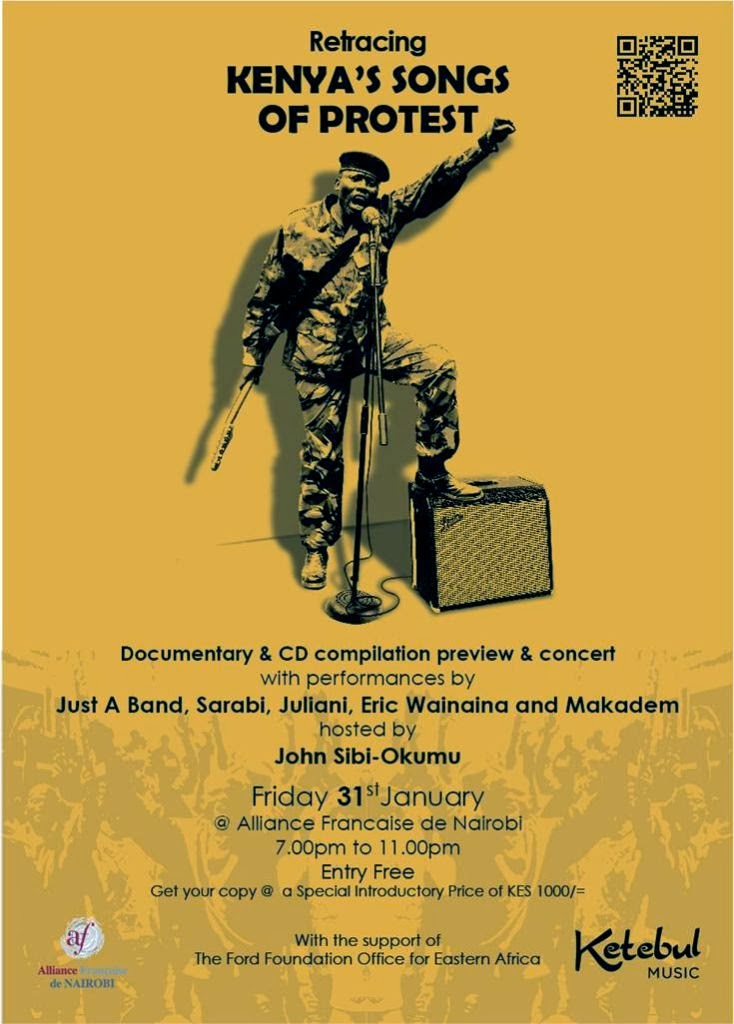
Event: Kenya’s Songs of Protest: Documentary & CD Compilation Preview Concert, Jan. 31 2014 @ Alliance Française

Songs of Protest
In the recent past Kenya experienced different forms of protest. The protests have ranged to the eye catching Occupy Parliament protests lead by photo activist Boniface Mwangi protesting the high pay Members of Parliament enjoy to the recent protests against new taxes by county governments.   

Musicians have not been left behind and you have quite a number of young musicians telling truth to the people in power through music. Some of this music is quite popular since it deals with issues of bread and butter and the current problems being experienced. 

Therefore the exhibition above ought to be a MUST attend event for anyone interested in issues of governance.

Particulars
Date: January 31, 2014
Venue: Alliance Française
Time: 7-11 pm
Free Entrance


Performance by: Just a Band, Sarabi, Eric Wainaina and Makadem
Hosted by: John Sibi-Okumu

Friday, January 24, 2014

Opportunity: Washington Fellowship of Young African Leaders 2014 by January 27 2014

Lecture: Origins of Political Order by Prof. Francis Fukuyama on Jan. 22 2014 @ Strathmore Business School

Lecture Poster
Professor Francis Fukuyana gave a lecture titled the Origin of Political Order on Wednesday evening at the Strathmore Business Auditorium. The lecture was premised on his most recent book going by the same title.  The professor kicked off his lecture by giving us a background on the thought process plus what influenced him to come up with this book. The September 11 2001 twin tower attacks by terrorist and America's quest to attack Iraq and result to a nation building war / exercise were the catalysts. Hence he embarked on a search of the origins of political order since intervention by the United States tended to get things wrong on the countries that they wanted to 'democratise'.

The professor also enumerated the evolution of political order and classified this into three components namely;

  1. The State [the formation of the state as we know it today by the Chinese and how war and dynasty conflicts was instrumental to this. Notable was the mention of German Sociologist Max Weber]
  2. The Rule of Law [under the rule of law the professor highlighted the role of religion and notable mention was Pope Gregory the 7th and his work on reforming the Catholic Church]
  3. Institutions of Accountability [Lastly, was democracy and why he prefers to Accountability as opposed to democracy]
On the last classification, the professor went to great lengths to showcase that in authoritarian regimes such as China there is considerable accountability in this case in economic terms. The central committee is try as much as possible to secure economic opportunities for its citizens and this nuance is as a result of its unique history. 


Lastly the Prof. Fukuyama tried to tackle Africa from the position of an outsider. He concurred with the Africa Rising narrative and made specific observations. He then concluded by making us aware of a sequel to his book will be published this year. The book looks at the origin of political order in Africa.

The output and learning points from Prof. Fukuyama was there is need to understand local nuances before engaging in democratisation projects by international institutions. I think his works might inform current concepts such as R2P.

Find Prof. Fukuyama Bio and his current projects here: http://fukuyama.stanford.edu/