Wednesday, June 15, 2011

Budget 2011/12

The Kenyan budget for the financial year 2011/12 was read on June 8, 2011 and despite the controversies that preceded it. It was read as a budget statement as opposed to budget speech. This is after the minister ignored to present estimates of his budget 2 months before the budget as clearly spelt out in the new leviathan. The civil society went to court to block the budget on this but they were not successful. However, Members of Parliament asked for an interpretation from the chair (speaker) who ruled that the budget should be presented to the house as a budget statement.
Despite all this it is worthwhile noting that it is a first in many ways;
  • It is the first time that our budget has hit the trillion mark (1.155 trillion)
  • It is the first budget read after enactment of a new constitution
  • The budget was being read by an ICC suspect
  • This is the budget prior to a general election
The Budgets theme was ‘Building Resilience, dealing with emerging challenges-Additions to spending plans’.

Highlights of the Budget
The budget read by the finance Minister enumerated the key macro-economic indicators of the country for 2010. The country GDP growth rate stood at 5.6% in 2010 from 2.6% in 2009 and it is expected that the country will register a 5.3% (revision downwards) GDP growth rate in 2011. The population Growth rate for 2010 was 3.1% and is expected to be around the same figure in 2011. The inflation stood at 4.1% for 2010 however it is expected to rise significantly in 2011 to about 9.3%.

The explanation for a rise in GDP by almost 100% is attributed to strong performance in Agricultural sector which contributes about a quarter of the GDP and a positive showing in the industrial sector. This is in contrast in 2009 when the country was recovering from the Post Election Violence (PEV) and Agriculture registered negative growth.

The high inflation (approaching double digit) expected for 2011 is a result of high food and oil prices. In fact the monthly inflation figures released by KNBS are in the double digit. The Kenya shillings has been on an all time low against the dollar and fuel hikes have become common with prices changing on a weekly basis if NOT monthly. To add to this in the month of May motorist experienced fuel shortages when the government tried to enter into this market (Oil Market) which some say is run by cartels close to the high and mighty. 
As if this is not enough the country has had its fair share of unemployment. The exact figures are not yet made known BUT one thing is that it is a double digit figure. The budget tries to address this challenge and this being an election year the 500,000 jobs per year first sprung up in 2002 NARC manifesto continues to be used. The government is reviving it Kazi Kwa Vijana (KKV) project that will see young persons given paying internships to make them ‘employable’.

Fiscal Policy
The government resources for financial year 2011/12 spelt out show that the government is going to finance its budget from;
Revenue Sources 2011/12
The A-word (austerity) has featured in the government expenditure programme where it is rationalizing to contain expenditure growth. However, analyst are pointing out that 2012 being an election year. Kenya has a record of having expansionary expenditure and that growth has been shown to slow. However, it remains to be seen if the new constitution and on going reforms are going to put a hold on this track record.
The other problems are the high internal borrowing (11%). This might tend to exaggerate the inflation problem. However, I spotted in the dailies the Central Bank of Kenya (CBK) has been announcing 10 & 20years maturing treasury bonds to wipe of excess liquidity in the market.
The finance minister also pointed out on tax reforms (VAT reforms) this might erode the 65% component of budget based on tax revenue but have a positive impact in the medium and long term. A simplified tax system is in every ones best interest.

Expenditure
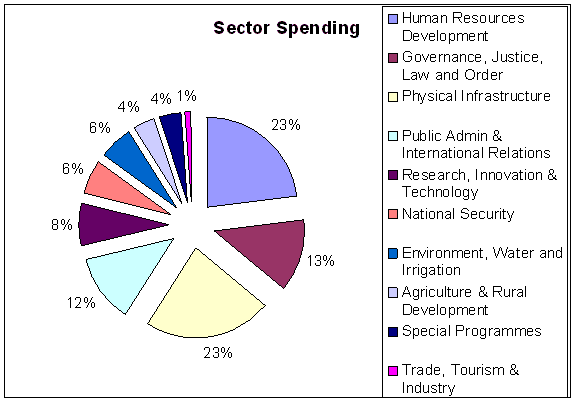
Sector Spending 2011/12

One of the key things that really got my eye is the proposed expenditure. As is the case the usual suspects still get their fair share however the government earned my points on allocating 5.6 Billion to the safety net. Under this it has set out Kshs 1 billion for older persons (people currently highly affected by high cost of living), Kshs 300M for Girl child and my favorite Kshs 845 M for Gunny bag grants for urban poor.
The gunny bags are going to be used in sack gardening in urban slums. These funds will scale up the Urban Food Security Program currently funded by European Commission and AFD in Urban areas of Nairobi, Mombasa and Kisumu.
Irrigation
The government has allocated to spend 6% of its spending on the irrigation. This has been warmly welcomed. The Agricultural Secretary Dr. Songa has noted this will go a long way in what the Ministry has been preaching, water harvesting.

Physical Infrastructure
The government is allocating a big chunk 23% same as that of Human Development on Infrastructure. It would be worth while to know who will be up-scaling/building the urban commuter railway.

Challenges Pointed
Absorption
The government has been shown to have a big problem with its absorption capacity. Kwame Owino the CEO of IEA has pointed out that at the end of the financial year ministries tend to return monies to the ex-chequer (Treasury) due to low absorption capacity in line Ministries.

Graft
It is now emerging that 4.2 billion was misused or ended up to its unintended purposes in the Ministry of Education. This had long been flagged by donor agencies who partnered with government to achieve this noble goal of educating the young citizenry through the Free Primary Education (FPE).
 

Friday, June 3, 2011

Trans-Century at Mind Speak

May’s edition of Mind Speak saw Transcentury parade itself in this monthly forum (which I regularly attend) organised by Aly-Khan Satchu a Financial Analyst who runs rich management

This was coming head over heals of April forum that had President of Uganda H.E. Yoweri Kaguta Museveni as the Guest speaker. What is fascinating about this company is that it is a company founded by 29 prominent personalities. These personalities have been accused of either being too close to the center of power or have used their positions to acquire contracts or use privy info BUT they have defended themselves as people who have acquired their wealth genuinely and in a range of counties in the region.

To pitch for this company Transcentury were; Dr. Gachao Kiuna (CEO) and Yida Kemoli (Head of Finance and Corporate Strategy).

Background of Transcentury
The CEO Dr. Gachao gave us a brief history of this company. It was started by 29 people (all men) who used to meet informally in what in Kenya we call ‘chama’. They all agreed to each contribute Kshs 1 million. So they expect to have an initial capital of Kshs 29 million however they ended raising Kshs 24 Million.

Their initial investment was in South African Breweries which had entered the Kenyan Market in 1998 only to close in 2002 after four-year beer war with Kenya Breweries and failing to secure a 10% of market share.
These investors managed to recoup their investment from SAB due to the fact that SAB pulled of the market by a negotiated settlement with Kenya Breweries Ltd (now East African Breweries Ltd, EABL).

Having learned from this experience the 29 vowed never to go for anything less than controlling stake in a company (51% of the share capital).

Present Day Transcentury
The 29 investors formed Transcentury which is a Holding company with interests in;

  • Power Infrastructure: Manufacture of Electrical Cables, Conductors, Transformers and Switchgear. 
  • Transport Infrastructure: Operation of the Kenya-Uganda Railway Concession.
  • Specialized Engineering: Distribution of Mission-Critical Industrial Equipment and Construction of Electrical Installations.  
The company has pan-African interest in outlook i.e. it wishes to invest in the whole of Africa and that is why as I came to find out it was at the event because it wants to list on the Nairobi Stock Exchange (NSE).

The company has 5 divisions i.e. Power Infrastructure, Transport Infrastructure, Specialized Engineering, Consumer and Affiliated Holdings.

Reservations
The company has raised some eye brows with its Transport Infrastructure division with people questioning the way it got into the concession of Rift Valley Railways (RVR) and the two guest speakers had a hard time convincing us. However, they had their side of the story.
The company seems to hedging on the railway considering it is has entered into partnership with a Brazil Railway company America Latina Logistics (ALL).

The other eye brow is that the company can’t seem to send away the ghosts of the 29 investors who as some would put it could raise the issue of ‘conflict of interest’ given that some of them are CEO’s of some of the divisions the company engages. To this the CEO pointed out that some of their major customers are you and me (ordinary folk) and NOT government parastatals.

The other observable omission in the company which was observed by Gina Din was that the company’s 29 investors are all men!

Going Forward
In the infrastructure sector given that most of the infrastructure building is done by Chinese Companies funded by China gov’t which has shown that it is willing to fund states improve their infrastructure. Does Transcentury know anything that we don’t? (A query raised by one of the participants).

Only time will tell however, should you want to know more about this company the CEO Dr. Gachao Kiuna asked the participants to visit any Dyer & Blair.

Presentation at Mindspeak (Pdf)

Photographic Exhibition: The People of Afghanistan

Yesterday evening June 2, 2011 I attended the opening of the above photo exhibition by Arvind Vohora. To say I was blown away by the photos gracing the walls of what used to be RaMoMa would be an understatement.
 What was so exiting for me about this photo exhibition was the subject it’s self- The People of Afghanistan. Afghanistan is a country which is deeply mirrored into the history books and getting a chance to get a glimpse of the people who live in this land is an opportunity I could not simply miss.
This country has been called a ‘grave yard’ for empires because many countries have ventured into it without understanding the geography, the people, their culture, the resilience of this people, their religion and such. So this exhibition in a way put on the table the day to day happenings in this country albeit in 1988 when the Mujahideen were kingpins! This was way before they had metathesized to Taliban and AL-Qaeda was in its infant stages.

Background
These photos were taken by Arvind in 1988 soon after getting married. As the invitation fly points out.
‘Wanting some excitements in his life after working for fifteen years as a commercial photographer, he got married and they left soon to spend a year living amongst Afghan refugees in Peshawar, Pakistan and traveling into Afghanistan with the Mujahideen.’
What a honeymoon it must have been!

Curator
The exhibition is curated by Sylvia N. Gichia of Kuona Trust who together with her team did a fantastic work of displaying the photos in terms of themes. This are; men and their trade, portraits of men, photos of women with children, men with their guns, cattle and my favorite men doing leisure playing polo albeit with a calf instead of a ball!

Excellent buys 
This photos can make an excellent buy or gift for Senator John Kerry ‘The Pakistan Whisperer’, the can be also be a good buy for Gen. Stanley McChrystal and Gen. David Paetrus authors of COIN or they would fit perfectly in a white house room that discusses issues of withdraw of US troops in Afghanistan.

Mind you, Charlie Wilson's War movie will provide an excellent context of what was happening in 1980’s in Afghanistan/Pakistan.

Wednesday, May 4, 2011

Jeff Koinange’s Interview with the Prosecutor

The ICC Prosecutor interview with K24’s Anchor Jeff Koinange just in case you missed it.


Youtube links:
Part 1, Part 2, Part 3 and Part 4

Thursday, April 21, 2011

China in Kenya

On Wednesday April 20, 2011 HE Mr. Li Changchun a member of standing committee of the Central Committee of the Communist Party of the People’s Republic of China gave a keynote address at the University of Nairobi. The key note address was titled; ‘Strengthening China-Africa Friendship & Co-operation to build a better tomorrow’.

As the name denotes the speech was intended for the whole of Africa. Considering that China has come up with a policy of engaging the whole of Africa under the Forum on China Africa Cooperation (FOCAC) initiative that predates early 2005.
So this was a major scoop for Kenya considering this kind of lectures would have perhaps been done in Egypt. Now that there is Uprising in the Arab world Kenya is now the reference point for China-Africa Co-operation.

Preparations
The run up to the Public lecture saw the University of Nairobi turned into a small ‘China Town’ of sorts. An exhibition was put up in record time from Monday April 18, 2011 to late Tuesday April 19, 2011. The exhibition: ‘As Others See US-China in the Eyes of African Artists’ was one of the best exhibitions put up by Chinese I have come to see to date.
It has around 30 paintings from 15 artists from all over Africa (Mainly the stations where China is HIGHLY present). Some of these countries and artists exhibited are Lesotho (Thakane Lerotholi), Ethiopia (Daniel Asfaw Tadesse), Zimbabwe (Tonely Ngwenya), Zambia (Gordon Shamulenge), Cape Verde (Bento Oliveira), Senegal (Amadou Camara Gueye), Tanzania (David Hezekia Mzuguno), Cameroon (Irene Mejane Epie), Tunisia (Mohammed Regaieg), Mauritius (Pascal Jean Francois Gaspard) and Kenya (a fine arts lecturer from KU).

D-Day
The public Lecture was commencing at 2.40pm and we had to be seated by 2pm. The security was tight but did not have the signature hullabaloo of the Americans. The Chinese perhaps a cognizant of this fact and do NOT like rubbing feathers in their hosts country. The University was awash with banners/posters going by ‘Warmly welcome HE Mr. Li Changchun to UON’ and ‘warmly welcome HE Mr. Li Changchun to CIUON’.

There were lots of Chinese in the Taifa hall auditorium taking photos with high end user camera’s (A sign of the high purchasing power of the Chinese in Africa).

At exactly 14.40hrs HE Li Changchun arrived to the hall accompanied by Hon. Helen Sambili (Minister for Higher Education, Science & Technology-Acting), Chinese Ambassador to Kenya, Chair of the University Council Prof. John Simba, The V.C. Prof. Magoha, PS Prof. Kiamba and the Chinese itinerary of HE Mr. Li.

The Principal CHSS Prof Mbeche made some opening remarks and welcomed HE Mr. Li to give the Keynote Speech.

HE Mr. Li began his speech by bowing to the audience and the high table. He then followed that his visit was meant to promote get together between the people of China and Africa. He extended the warm wishes of his people to the brotherly people of Kenya and Africa. He observed that Kenya was a friend in East Africa and a strong partner.

FOCAC
He noted that since the last presidents delegation in Beijing China had honored its end of commitments to Africa despite harsh economic times. In total China have over 500 projects in Africa worth around 30 billion.

He also mentioned that China and Africa have been able to maintain the strong bond because they have fought colonialism, advocated Independence. He noted that China was a country that respects countries despite their sizes (Large or small) and has been against bulling from western governments. China also advocates for equality and their relationship has provided tangible benefits to both parties.

HE Mr. Li noted that his country is looking for deep and pragmatic friendship from Africa and hinted that a pragmatic strategic relationship was on the works from Beijing.
He also suggested the following four points to Africa which they should cultivate with China;

  1. Enhance Political Relationship with China
On this he encouraged and high level exchange between members of Kenyan Political Parties and Chinese Communist Party. On his visit to Kenya he mention of meeting the President, the Vice President and the Speaker of the National Assembly.
He invited the high level members in their respective parties to visit China and learn a thing or two from the Communist Party of China.
He also mentioned that his country China was looking to cultivate high level friendship among members of government, legislature and political parties.

  1. Promote Economic being and reciprocity
China was joining Africa in mutual trade opportunities. Some of the areas China is looking to invest is Agriculture, Medical care etc. China was looking to promote development of Africa as a whole.
On his part Mr. Li shared with us that China was encouraging capable and trustworthy Chinese Companies to work in Africa. This he said will contribute to employment and economic well being to Africa.
China will also provide assistance to Africa in the following areas;
    • Education
    • Agriculture
    • Healthcare
    • Energy Conservation & Environmental Protection
During his last day in Kenya he will over see the signing of a concession loan worth 750,000 Chinese Ruan. Some of these monies will over see the construction of a referral hospital in Kenyatta University.

  1. Encourage People to People Exchange
This he noted will foster and deepen friendship through cultural exchanges. He personally was going to encourage the interaction of Chinese youngsters, women, media, institutions of higher learning/academics etc with Africa.
He doubled the number of scholarship China had offered to Kenyan Students from 32 to 64 on this day.
On tourism he directed China TV, CCTV to produce more documentaries about Kenya especially the Rift Valley so that more Chinese tourists can come and visit the country. This he noted will contribute to lowering of the deficit that exist between Kenya-China.

  1. Strengthen Communication (Consultation & Coordination)
This is to enable the developing country have one voice in the international community. He looked forward to more consultation especially from African Union, AU to come up with common stand points on the following issues;
    • Sovereignty
    • Security
    • Territorial Integrity
    • Food Security

Present Day China
He noted that the communist party will be celebrating its 90th Anniversary. He noted under the 90 years the party had undergone revolution, contestation and reform (last 30years of reform & opening up).
Under the last 30 years he noted the party had adopted ‘Socialism with Chinese Characteristics’.
HE Mr. Li seemed to be a realist person in that he noted as much as people are talking about China being a super power there was a huge discrepancy in its GNP Vs Per Capita income. He briefly talked about the Delegates Coference in March and how china was adopting a new blue print for the next 5 years whose theme or backdrop is ‘scientific development’.
He noted that development of the world and that of China was interlinked and that no one should fear China as it is seeking a harmonious world of lasting peace and prosperity.

Youth
He correctly pointed out that most of the audience were young people and he quoted Mao Zedong ‘World belongs to you (youth) and us (old)’.
On a light note he said the youth present made him feel young and he was relishing the university years (40 years ago!).
He noted a lot of volunteers were coming to Africa and China was institutionalizing this and we should expect more Confucius Institutes in Africa.

Bottom Line
HE Mr. Li Changchun seemed to be genuine about his message he was delivering on behalf of his people. However, there was no Q&A which was removed at the last minute due to ‘time’ constraints.

NB: The lecture was given in Chinese with an interpreter translating it to English.
Li Changchun, a member of the Standing Committee of the Communist Party of China Central Committee's Political Bureau dances with students from Nairobi University, in Nairobi, Kenya, April 20, 2011. Li gave a speech at Nairobi University on Wednesday.(Xinhua/Zhao Yingquan)

Monday, April 18, 2011

Ask the Court Sessions

The ICC has launched a series of ‘Ask the Court’. A brilliant way to correct all the wrong information and misconceptions flying around as a result of lack of knowledge or so called ‘experts’ who go around giving the wrong facts about the ICC process.

Initial appearance at the ICC

In case you missed. Below are the videos of the Ocampo 6 initial appearance to the ICC.
This was the first time we were actually seeing a live ICC court in session and what stood out at the Pre-Trail Chamber no. 2 was the Presiding Court Judge Ekaterina. 
I will NOT be surprised if a child is named after her (going by the huge ratings the prosecutor enjoys in our country-Kenya.) Children, cars, wildlife (Cheetah) have been named after him! and going by the street talk most of the people I know were amazed by the way the presiding judge was firm yet fair.

Wednesday, April 13, 2011

The Prosecutor ‘Benched’

Those who know me will tell you that I love Capital Talk which airs on K24. Given the number of soaps in our television sets I had turned on to Kiss TV however they re-branded and things got from good to as worse as they could be!  

Hence my love affair with Capital Talk which is brought to our sitting rooms everyday at 8 and 10.30pm by the so able Jeff Koinange (a former CNN Africa reporter). Among the personalities he has interviewed are seating and former head of states, public personalities, businessmen, entrepreneurs and normal Kenyans with extra-ordinary stories to tell.

Last year, I remember Blogging about M. Wrong on the bench (one of my favorite last year not to mention former Nigerian President Olusegun Obasanjo).

This year, I remove my hat to Jeff Koinange and his K24 crew for securing an interview with the International Criminal Court (ICC) prosecutor, Luis Moreno Ocampo.
This was done in the sidelines of the summons of the Ocampo 6 at The Hague i.e. the first week of April 2011.

It was note worthy that Jeff Koinange managed to give us a glimpse of the prosecutor we had NOT seen. The picture of the prosecutor I had observed was the emotionless, no none sense person but we got to know a bit about where he hails from Argentina if you missed. He was the prosecutor of the top military generals who had committed crimes in Argentina when South America competed with Africa in that respect. This story has radically changed with time as a result of good governance. Countries such as Brazil are the engines of economic growth in the world and offer alternative development paradigms.

The prosecutor told as a little bit about his background. His grandfather was a general in the Argentine army and his father a colonel. He also, spoke a bit on his stint as the lead prosecutor in Argentina military trials. He talked about how he was loathed by the whole country (including his own mother!) but later turned to be loved. Talk of being on the right side of history.
He also alluded that he is a man of passion. By this I mean he seeks the things that he has a passion for. Perhaps this can explain the jest in which he takes his work. This is because he has a passion for it!
He also talked of being an optimist. In that he sees the glass half full as opposed to being half empty.

The Prosecutor and Kenya
During the interview the prosecutor was under no illusion that he can single handedly change the country pointing out that as a prosecutor he cannot FIX our country. He did point out that it is up to Kenyan’s to decide who their leaders are and that all he was doing was prosecuting the person’s who had the greatest responsibilities for Post Election Violence (PEV) in 2008. He is doing this under the mandate of the international community. He was however, optimistic that though the ICC process he can contribute in the transformation process of Kenya to become a better country in a ‘small’ way.

Elections in Africa
On the Kenyan case he pointed out that this cases at The Hague are different form other in that this is about a disputed election. Unlike, the Bemba case (DR Congo) and Kony (Northern Uganda) which are about contested spaces (warlords).

Considering there are about 16 elections to be conducted in Africa in 2011-2012. It is imperative the international community gives clear signals that the habits that are synonymous with Africa incumbents of rigging elections and clinging to power are brought to an end.
So this is a chance for Africa to change.

The prosecutor also alluded to the fact that he would like to be invited to witness the swearing in ceremony of the president elected after the 2012 elections.

Kenya and Sovereignty
Some of the people leading for the trial of the so called Ocampo 6 have made their arguments around the issue of sovereignty. Arguing that cases brought to the ICC are for failed states.
In fact, the debate has been so intense as to come to the point of challenging the normal business of NGO’s, civic society and diplomatic mission.

However, when Jeff put this question to the prosecutor he was of the opinion that Kenya will show the world an example of how to go about in terms of a dispute. The prosecutor pointed out that Kenyan’s will come out of this process being winners. 
This is rightly so considering Kenya will be the first nation to question admissibility of the court among the Rome statute signatories.

ICC Cases
The prosecutor alluded to his thoughts and perspective on the cases he is prosecuting. When asked about his thoughts on the PEV cases. At first he thought it was a police operation when the chief mediator Kofi Annan presented him with the ‘Waki’ envelope.

However, the evidence pointed in to two distinct cases. These cases were the people who planned the violence in case of defeat and the people who reacted to the violence. Hence he built his case on this.
It is on his explanations that I fully understood how journalist Sang had come into the picture i.e. attending meetings and giving signal while broadcasting. This is opposed to what I had in mind i.e. propaganda.

When asked if he had any personal vendetta on the suspects he answered on the contrary. He said he did not have any grudge against anyone despite even Mr. Ruto calling the prosecutor ‘an evil man’. He talking of having shaken their hands and that he would be happy if they proved him wrong in court. Eluding to the fact that JUSTICE is NOT about putting people in JAIL. It is about TRUTH.

Retirement Plans
The prosecutor also hinted on his retirement plans given that his term at ICC as a prosecutor comes to an end in 2012. Some of his achievements will be living an institution in place with his office of 300 staff.
He pointed out that he could retire to Harvard.

However, in the mean time he is looking forward to great legal debates in court. Given the suspects have very good defense councils. 

Tuesday, April 12, 2011

The ICC Process and Kenya

Background
April was a month where all of us (Kenyan’s) were looking at The Hague. This was as a result of being bombarded with news of Ocampo 6 and their scheduled trip to The Hague. For those without a clue on what the phrase Ocampo 6 means. This are the 6 individuals that the Prosecutor of the International Criminal Court, ICC Mr. Louis Moreno Ocampo perceived to have the most to answer about the post election violence that grappled Kenya after the bungled polls of December 2007.

All of us saw on the television sets in early January 2008 as a Kenya almost went to the dogs as the two feuding parties ODM and PNU tried to settle their scores outside the ballot. It had to take the intervention of seasoned diplomat Kofi Annan, the immediate former UN Secretary General for cessation of hostilities between the two groups and the formation of a coalition government to take us through until 2012.

Under this process 4 agenda’s were agreed with the first being the cessation of hostilities and formation of a coalition government. Others were formation of Judge Waki and Kreigler commissions with the former required to look at the persons responsible for the injustices and the latter to determine what went wrong in the election process. Both this commissions gave their finding known with Waki commission and Kreigler commissions presenting their finding to the two principles. The Kreigler commission went to as far as to say it was impossible to determine the clear winner in the 2007 polls while the Waki commission presented a secret envelope to the chief mediator Kofi Annan. The suspects in the Waki envelope were to be either tried locally or taken through an international process. The other agenda was the enactment of a new constitution which is already in place.

International Criminal Court
In mid December 2010 the Prosecutor announces the 6 suspects that in his opinion bear the greatest responsibilities for the Post Election Violence and the death of over 1000 people and displacement of over 100,000 persons internally. The 6 suspects were William Ruto (then Minister of Higher Education), Uhuru Kenyatta (Dep. PM and Minister of Finance), Francis Muthaura (Head of Civil Service), Henry Kosgey (then Industrialization Minister and head of ODM), Maj. Gen. Hussein Ali (Post Master General and former head of Police) and Sang (a little known journalist).

The announcement of this names sent shock waves to the highest echelons of the Kenyan government. Since most of the parliamentarians when presented with a local judiciary mechanism thought that the ICC would never come calling in and ‘IF’ it did the it would take ‘light years’ for the process to commence. Furthermore, most were of the opinion that the Waki envelope did not contain their names and at most the responsibilities of Post Election Violence would be weighed by the principals.

However, the prosecutor had pulled a fast one on them! He was not going after ‘Political Responsibility’. He was going after those who planned attacks in certain parts of the country and executed those plans. He was also going for the jugular of the people who responded to these attacks by organizing counter attacks.

The Administration hits backs!
When it clearly sunk in to one part of the coalition government that The Hague process was NOT vague as had earlier been assumed. That part of the coalition started to plan a counter offensive to this route.

This came through the botched appointment of Chief Justice. An episode that saw the president ‘eat’ humble pie by taking back four constitutional nominations. This was done early in February 2011 before a scheduled AU head of state conference. This episode almost saw the split of the coalition.

The other was through the infamous ‘shuttle diplomacy’. The vice President of the Republic flew on the tab of tax payers to different capitals of the world to woo major players in the world to support an AU sponsored motion to deferrer the ICC case for 1 year on account of expected election in 2012.

When the shuttle diplomacy hit a snag the government went to the last option of contesting jurisdiction of the Post Election Violence cases at the ICC.

Perhaps it is on this account the prosecutor instigated early summons of the suspects to the ICC on April 6-7, 2011.

Count Down to The Hague
As the D-Day approached 4 of the Ocampo 6 engaged in a series of Public rallies and cum Prayer meetings. Perhaps when it dawned on them that The Hague had become inevitable.
However, some of these rallies had what Judge Ekaterina Trendafilova called ‘dangerous speeches’ that could see the recurrence of violence.

As The Hague date approached the government became disorganized in terms of the approach to take to save the six high level persons.

However, what came as a shocker was that 40 MP’s were accompanying the six to The Hague.

D-Day I (April 6, 2011)
This was the fist we were seeing of the ICC in action. On this day saw the appearance of William Ruto, Henry Kosgey and Sang at the ICC chamber 2.

What stood out for me was the sheer timeliness (the three were warned for 3 minutes delay) efficiency and clarity of the court.
We also got to know the defence council of the suspects, the court registry, the prosecutor team and the judges.

We also witnessed drama and side shows of Kenyan MP’s who accompanied the 6 to The Hague. (Mind you most of the TV station had crew at The Hague reporting LIVE!). This lead to a joke of Nation TV was doing county edition aka Hague County (48th County)!

D-Day II (April 7, 2011)
On day 2 of the ICC we saw the defence council of the other 3 suspects. However, saddened to learn this group (nick-named by the Kenyan Press-All the Presidents Men!) had few if none Kenyan’s in their defense council.

Reflections/Questions Arising
Now that we have a Hague process going on it is time to have a local mechanism to try the ground soldiers of the post election violence. To out as one member of Bunge la Mwananchi put it. The Hague Process is like a rabbit it would be over without us knowing it serving a Western kind of Justice. We need a Tortoise mechanisms which will lead to trying of small perpetrators which will take time become an example to local folk not to be used and misused.

We need to know what the government was conceding during the negotiation for so called shuttle diplomacy. Something MUST give and the public ought to be informed on concessions made for support of Kenyan deferral at the UN Security Council.

A mechanism needs to be adopted for future shuttle diplomacy mission. A clear guideline should be tabled and at first instance diplomatic missions in the country need to be the first reference points for such endeavors.